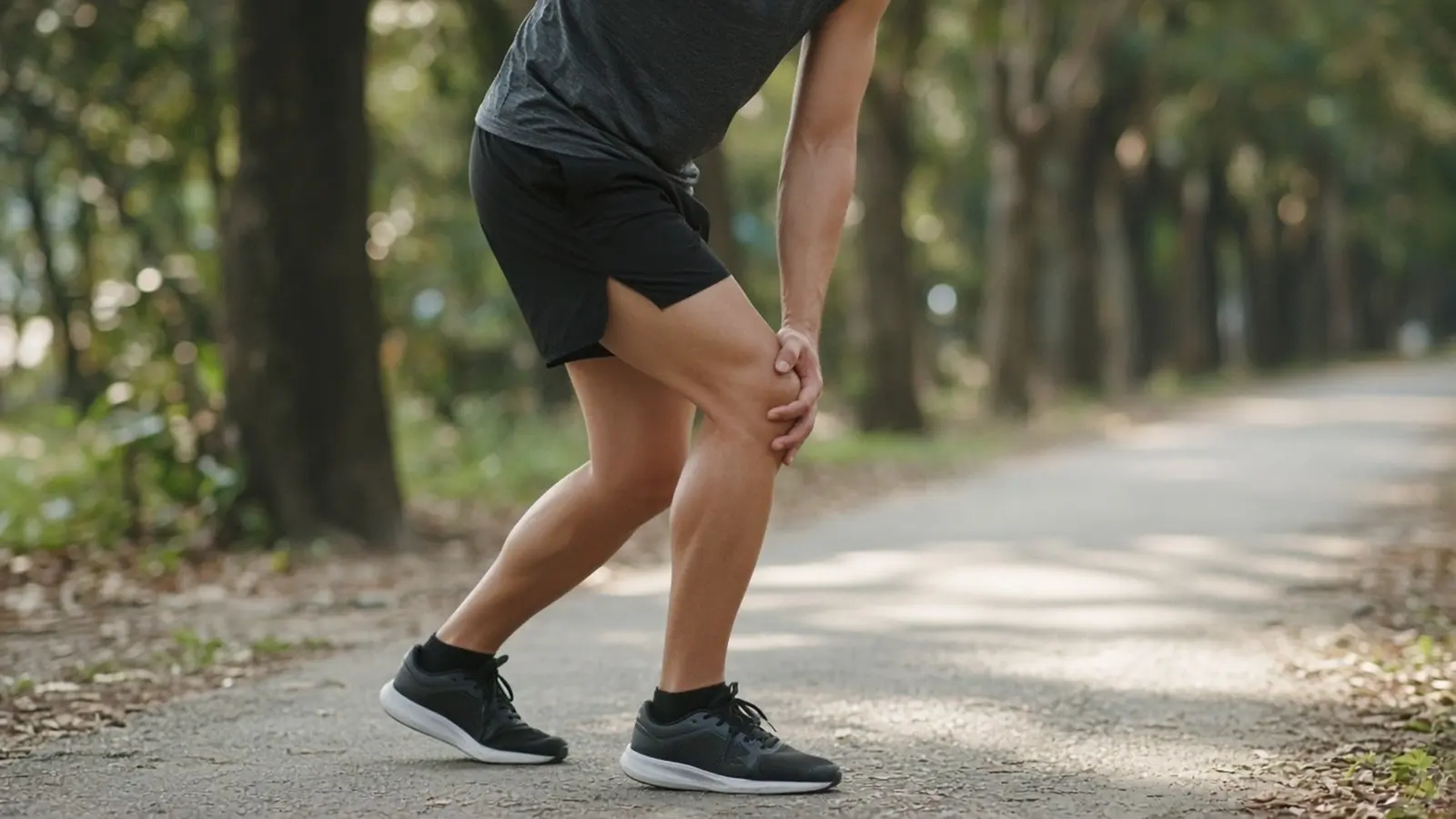
Pain at the back of the knee when you straighten the leg most often comes from a Baker's cyst, a strained hamstring or calf muscle, a torn meniscus or, after a heavy impact, a posterior cruciate ligament injury. A swollen, warm, throbbing calf is different: that pattern can be a deep vein thrombosis and needs a doctor the same day. Most of the other causes settle with rest, ice and gradual movement, and the NHS says knee pain that has not improved within a few weeks should be seen by a doctor.
What causes pain at the back of the knee when straightening the leg?
Pain behind the knee on straightening comes from one of five structures: the fluid-filled Baker's cyst that sits in the popliteal fossa, the hamstring and calf (gastrocnemius) muscles that cross the back of the joint, the meniscus cartilage inside the joint, the posterior cruciate ligament (PCL), or the popliteal blood vessels. Straightening the leg stretches the muscles and squeezes the back of the joint, so each of these hurts in that position.
The NHS knee pain page groups causes by whether there was an injury. After a twist or over-stretch during exercise, it lists sprains and strains; a knee that gives way, will not straighten or popped during the injury points to a torn ligament, tendon or meniscus. With no obvious injury, it lists osteoarthritis (pain and stiffness in both knees, more common in older people), bursitis, bleeding into the joint, and gout or septic arthritis (hot, red, sudden severe pain).
The NHS Baker's cyst page says cysts in adults usually develop when another condition damages the joint, naming knee injury, osteoarthritis, rheumatoid arthritis and gout. So in India's over-40 population, where knee osteoarthritis is common, a Baker's cyst and the arthritis behind it are often found together.
Two causes are not musculoskeletal at all. A deep vein thrombosis (DVT) in the calf or thigh and a popliteal artery aneurysm can both present as pain or swelling behind the knee; Cleveland Clinic says a popliteal aneurysm is hard to diagnose precisely because DVT and Baker's cyst look similar. The next section separates them by their clues.
How do I tell which cause I have?
Onset, location and what you can see or feel separate the causes before any scan. The clues below come from the NHS, the American Academy of Orthopaedic Surgeons (AAOS) and Cleveland Clinic.
| Cause | Typical clue |
|---|---|
| Baker's cyst | Soft lump behind the knee, stiffness, trouble bending, worse after walking; often with arthritis (NHS) |
| Hamstring strain | Sharp pain at the back of the thigh during sport, sometimes a pop; bruising after a few hours (NHS) |
| Calf (gastrocnemius) strain | Sudden calf pain on a push-off, trouble standing on toes, trouble bending the knee (Cleveland Clinic) |
| Meniscus tear | Pop at injury, knee stiffens and swells over 2 to 3 days, catching or locking, loss of full range (AAOS) |
| PCL injury | Strong force to a bent knee (dashboard, fall); pain and swelling build quickly, limp, knee may give way (AAOS) |
| DVT | Throbbing pain in one calf or thigh, swelling, red, blue or darkened skin; no injury needed (NHS) |
| Popliteal aneurysm | Usually silent; pulsating lump; if it clots, pain, numbness and a cold pale leg (Cleveland Clinic) |
Three questions narrow it. Was there an injury? A twist favours strain or meniscus, a heavy impact favours PCL, no injury favours cyst, arthritis or DVT. Is there a lump? Soft favours a cyst, pulsing an aneurysm. Is the lower leg swollen, warm or discoloured? That favours DVT or a ruptured cyst; both need a doctor the same day.
Is it a Baker's cyst?
A Baker's cyst is the likeliest cause if there is a soft lump behind the knee with stiffness and difficulty bending. The NHS says the main symptom is a soft lump at the back of the knee, with pain, stiffness or aching, difficulty bending and clicking, and that symptoms may be worse after walking. Cleveland Clinic adds swelling that can extend into the thigh or calf, and notes some people have no symptoms at all.
The cyst is a sac of joint fluid pushed out through the back of the joint; Cleveland Clinic says a damaged knee makes extra fluid, which can drain only backwards. The NHS says cysts are more common between 35 and 70 and usually follow a knee injury, osteoarthritis, rheumatoid arthritis or gout.
Treatment follows the cause. The NHS says a Baker's cyst does not always need treatment, often improves when the underlying condition is treated, and can take a few months to a few years to settle; options include painkillers, a hydrocortisone injection, physiotherapy and draining the fluid. Cleveland Clinic says most cysts go away within a few weeks once the joint swelling improves.
A cyst can rupture. Cleveland Clinic describes sharp, stabbing pain in the knee or calf, calf swelling, a feeling of fluid running down the leg, and discolouration that resembles a blood clot. The NHS says a burst cyst and a DVT look alike, both need urgent assessment, and a rupture takes a few weeks to settle.
Is it a hamstring or calf muscle strain?
A strain is the likeliest cause if the pain started suddenly during running, jumping or a kick and the muscle is tender, swollen or bruised. The hamstrings attach just below the back of the knee; the gastrocnemius starts just above it. Straightening the leg stretches both, so a strain in either hurts behind the knee.
The NHS hamstring page describes a sharp pain in the back of the leg, sometimes with a snapping sensation or a pop in severe cases, followed by tenderness, then swelling and bruising after a few hours, and difficulty standing or walking. Cleveland Clinic's calf strain page lists sudden calf pain, swelling, bruising, a popping feeling, difficulty standing on the toes and difficulty bending the knee, and says risk rises after 40, with poor conditioning, tight calves and previous leg injuries.
Recovery depends on grade. The NHS says mild hamstring injuries usually improve within a few days and severe ones take weeks or months; Cleveland Clinic says calf strains can take weeks or months and re-injury is more likely afterwards. The NHS sprains and strains page says most improve within 2 weeks and advises no running for up to 8 weeks.
One caution: Cleveland Clinic says research shows up to 10% of people with calf-pull symptoms have a DVT. A calf that is swollen and warm without a clear injury is not a strain until a doctor has said so.
Could it be a meniscus tear or a PCL injury?
Suspect a meniscus tear if the knee catches, locks or will not go through its full range after a twist; suspect a PCL injury only after a heavy blow to a bent knee. Tears at the back horn of the meniscus, the cartilage pad between thigh and shin bone, are felt behind the knee.
The AAOS says acute tears often happen in sport from a pivoting or cutting motion, and that a worn meniscus can tear from an awkward twist getting up from a chair. You might feel a pop, most people can still walk, and over 2 to 3 days the knee becomes stiffer and more swollen. Symptoms are pain, stiffness and swelling, catching or locking, giving way, and loss of full range of motion. Only the outer third has a blood supply and can be repaired; inner tears are trimmed. Partial meniscectomy heals in about 3 to 6 weeks; a repair takes 3 to 6 months of rehabilitation.
The PCL stops the shin bone sliding backwards. The AAOS says it is stronger than the ACL and injured far less often, that injury needs a strong force such as a bent knee striking a dashboard or a fall onto a bent knee, and that it is rarely caused by a simple misstep. Symptoms are pain and swelling that build quickly, stiffness, a limp and a feeling the knee may give way. Many partial tears heal with bracing and quadriceps strengthening; full recovery after reconstruction typically needs 6 to 12 months.
When is pain behind the knee a blood vessel emergency?
Pain behind the knee is an emergency when the lower leg is swollen, warm or discoloured, because that is the picture of a deep vein thrombosis. The NHS says DVT causes throbbing pain in one leg, usually the calf or thigh, swelling, and red, blue or darkened skin. Risk factors include recent surgery, bed rest of 3 days or more, journeys over 4 hours, pregnancy, cancer, being over 60 and smoking. A suspected DVT is referred for ultrasound within 24 hours and treated with blood thinners for at least 3 months.
See a doctor the same day if one calf or thigh is swollen, throbbing, warm or discoloured, or if a lump behind the knee pulses. Call 112, India's emergency number, or go to the nearest emergency department at once if leg pain or swelling comes with breathlessness or chest pain; the NHS says these can be signs of a clot in the lungs. Do not drive yourself.
The rarer vascular cause is a popliteal artery aneurysm, a widened artery behind the knee. Cleveland Clinic says it affects about 7 in 100,000 men and 1 in 100,000 women, mostly over 50, and is usually silent until it clots or bursts. A clot causes pain, numbness, coldness, weakness and pale skin; a burst causes pain, swelling and bruising behind the knee. About 15% of people whose aneurysm clots need an amputation, so a pulsing lump is never watched at home. A duplex ultrasound is the first test for both; Indian district hospitals run it in the emergency department.
What can I do at home for pain behind the knee?
For a strain, a sprain or a known Baker's cyst, the NHS self-care formula for the first 2 to 3 days is PRICE. From the NHS sprains and strains and hamstring pages:
- Protect the leg and stop sport.
- Rest: avoid weight through the leg at first.
- Ice: an ice pack or frozen vegetables wrapped in a tea towel for up to 20 minutes every 2 to 3 hours (about 10 minutes at a time for a Baker's cyst).
- Compression: a snug, not tight, bandage by day, removed at night.
- Elevation: the leg raised on a pillow.
- No heat, alcohol or massage for the first 2 to 3 days; they increase swelling.
- Once pain allows, keep the joint moving.
For pain, the NHS suggests paracetamol, or ibuprofen as gel or tablets; take ibuprofen with food, leave 4 hours between doses, do not use tablets for more than 10 days without a doctor, and avoid it with stomach ulcers or heart, liver or kidney conditions. The NHS says knee pain should start to improve within a few days.
Do not ice, compress or massage a leg that could have a DVT; see a doctor first. And do not keep resting a knee that has settled: the NHS says most sprains and strains improve within 2 weeks and that physiotherapy helps when recovery is slow or the injury recurs. A physiotherapist can set a hamstring and quadriceps programme, which the AAOS calls a key factor in PCL recovery.
When do I need a scan or a specialist?
You need a scan when the knee locks, gives way, cannot bear weight or has not improved after a few weeks, or when a DVT or aneurysm is possible. The NHS knee pain page says to get urgent help if the knee is very painful, you cannot move it or put weight on it, it is badly swollen or misshapen, it locks or gives way, or there is a high temperature with redness and heat around the joint, which can mean infection. See a doctor if pain does not improve within a few weeks.
Which scan depends on the suspected cause:
- Ultrasound shows a Baker's cyst, a DVT and a popliteal aneurysm; the NHS says a suspected DVT gets ultrasound within 24 hours.
- MRI shows soft tissue. The AAOS says MRI is the preferred method of diagnosing acute meniscus tears and images the PCL better than X-ray.
- X-ray does not show a meniscus tear (AAOS) but finds arthritis and, in PCL injury, a bone fragment pulled off by the ligament.
An orthopedic doctor handles the joint causes and decides on an MRI scan; an emergency doctor arranges the ultrasound for a suspected clot. The AAOS notes that imaging can look normal in a PCL injury more than 3 months old, so describe the original injury precisely. In India a government hospital orthopaedic clinic sees knee injuries without a referral. This guide is general information from the sources listed below, not medical advice; a registered doctor makes decisions with you.