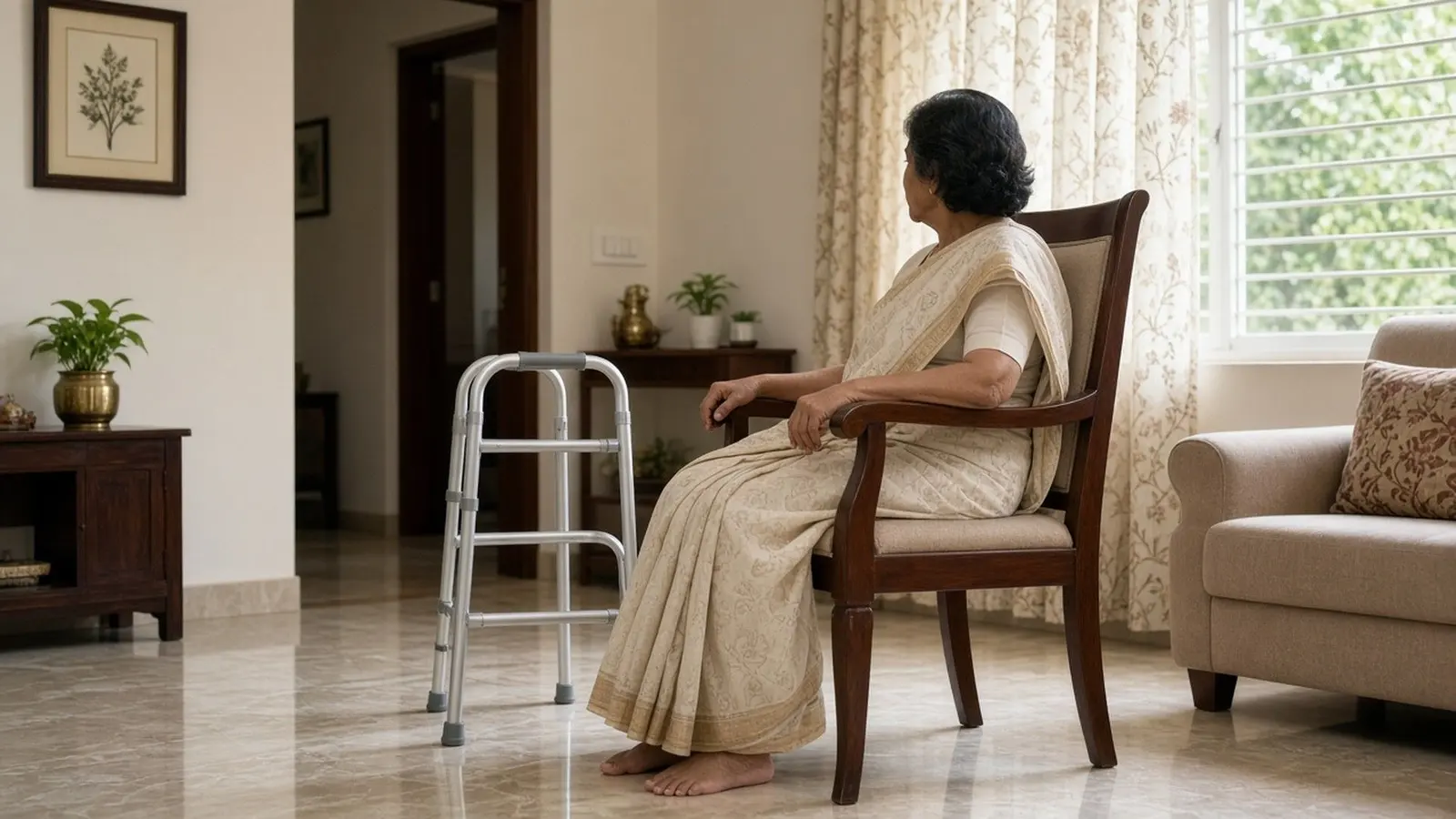
Most people with a stable pelvic fracture can sit in a chair from the first days, as long as they keep to the weight-bearing rule their surgeon set and use a firm, high chair with armrests. The sitting itself is rarely the problem; the transfer from bed to chair is, so the technique matters more than the cushion. Cleveland Clinic puts typical healing at 8 to 12 weeks, and MedlinePlus advises getting up and moving before 45 minutes in one chair.
Can I sit in a chair with a fractured pelvis?
Yes, for most pelvic fractures, once the surgeon has said which parts of the pelvis can take load. The AAOS (American Academy of Orthopaedic Surgeons) describes two broad groups. A stable fracture usually has one break with the bone ends lined up, such as a pubic ramus or iliac wing fracture, and often follows a low-energy fall; it is treated with walking aids, pain relief and an anticoagulant. An unstable fracture usually has two or more breaks with displacement, follows a car crash or a fall from height, and is fixed with an external frame or plates and screws. Pelvic fractures make up about 3% of adult fractures, and Cleveland Clinic says mild ones are commoner in older adults with osteoporosis while severe ones peak between ages 15 and 28.
Sitting loads the ischial bones (the sitting bones) and the sacrum, so the surgeon's instruction depends on which bone is broken. A 2015 review in the Journal of Orthopaedic Science by Rommens and colleagues, based on 245 older patients, allows weight bearing as tolerated after a few days of bed rest for fractures confined to the front of the ring (their Type I), and keeps patients with fixed posterior fractures on relative bed rest for about six weeks, with short transfers and sitting in a wheelchair allowed. Ask the surgeon two questions before you leave hospital: how much weight can go through each leg, and whether there is any limit on sitting time.
What weight-bearing rule should I follow?
Follow the exact level written on your discharge sheet, because the level decides how you sit down and stand up. MedlinePlus defines the four levels a provider can set: non-weight-bearing (the injured leg does not touch the floor), touch-down or toe-touch (toes touch for balance only), partial weight-bearing (a stated amount of weight), and weight-bearing as tolerated (more than half your body weight if it does not hurt). The AAOS says crutches or a walker are used to keep weight off the injured side, often for up to 3 months or until the bone has healed, and that someone with both legs injured may need a wheelchair for a period.
Practice differs, and the sheet beats any article. A 2023 survey of 169 orthopaedic and trauma surgeons in the Journal of Clinical Medicine found that 90% advise immediate weight bearing as tolerated after non-operative treatment of pelvic ring fractures in older adults, while only 42% advise immediate full weight bearing after surgical fixation and up to 39% delay it by at least four weeks. The same paper notes that disuse of the legs for as little as 4 days causes long-term loss of muscle function, which is why surgeons push for early sitting and short walks.
In India the rule is usually written on the discharge summary as NWB, PWB or FWB. If it is missing, phone the hospital rather than guess; an orthopaedic doctor can confirm it from the X-ray or CT scan report.
How do I get from bed to chair without pain?
Move in stages, keep the injured side straight, and let the arms do the lifting. MedlinePlus gives the sequence for getting out of bed after surgery, and it applies to a pelvic fracture: turn onto your side, bend the knees so the legs hang over the edge, push up with the arms until you sit on the edge, pause to check for dizziness, then push up to stand. Reverse it to get back in: sit on the edge, swing the legs up slowly, lower onto the side with the arms, roll onto the back.
To sit in a chair with crutches, MedlinePlus lists five steps:
- Back up until the seat touches the backs of your legs.
- Slide the injured leg forward and balance on the strong leg.
- Hold both crutches in one hand on the injured side.
- Grip the armrest, seat edge or toilet rail with the free hand.
- Lower yourself slowly.
Standing up is the reverse: scoot to the front of the seat, injured leg forward, crutches in one hand, push up from the seat with the other, and only take a crutch in each hand once you are steady on the strong leg. Pivot on the strong leg to turn, never the injured one, and do not hop. MedlinePlus advises someone with you for the first transfers and no more than 2 or 3 bed-to-chair trips a day in the first days.
Which chair, cushion and height work best?
A firm chair with armrests, high enough that the hips sit above the knees, is the right chair. MedlinePlus, in its hip fracture discharge advice, tells patients to avoid low chairs and soft sofas where the knees end up higher than the hips, to choose chairs with armrests because they make standing easier, to keep both feet flat on the floor without crossing the legs, and to get up and move before 45 minutes in one position. The same page says to use a raised toilet seat for the first couple of weeks and a bed low enough that the feet touch the floor when sitting on its edge.
A cushion is useful only when it keeps to that rule. A firm, flat cushion that raises the seat so the hips stay above the knees helps on a standard Indian plastic or wooden chair; a soft, sinking cushion does the opposite and makes standing harder. Ask the physiotherapist before using a ring cushion, because it tilts the pelvis. 
Avoid floor sitting, low diwans and charpoys for the whole healing period, because getting up from them loads the pelvis and needs bending at the hip that MedlinePlus advises against.
At home, MedlinePlus advises handrails by the toilet, a non-slip mat, no loose rugs or cords, and a ground-floor bedroom if the house has stairs. A folding commode chair and a raised toilet seat are available at surgical stores in most Indian cities.
How do I control the pain enough to sit?
Take the prescribed painkiller on a schedule in the first days, and time the dose about half an hour before transfers and physiotherapy. The AAOS says pain after a pelvic fracture is managed with a combination of opioids, non-steroidal anti-inflammatory drugs and local anaesthetics, with opioids used at the lowest dose for the shortest time, and it tells patients to report pain that is not improving within a few days. MedlinePlus adds that getting up and moving also reduces pain, and that alcohol with pain medicine can cause a bad reaction.
Pain that does not settle is a signal, not something to sit through. Rommens and colleagues advise a repeat CT or MRI when pain persists or worsens in a fracture that looked stable, because an occult sacral fracture or a more unstable pattern may have been missed on the first X-ray. Numbness or tingling in the groin or legs and difficulty passing urine are listed by Cleveland Clinic as symptoms of the fracture itself and need the surgeon to know the same day.
- Use ice wrapped in cloth over a bruised hip for 15 to 20 minutes at a time if the surgeon agrees.
- Keep the knees slightly bent with a pillow under them in bed; the AAOS notes patients often hold the hip or knee bent to ease pain.
- Do the foot and ankle exercises the physiotherapist set; the AAOS lists them as the first stage of recovery.
How do I prevent blood clots while sitting for weeks?
Move the feet every hour, take the anticoagulant exactly as prescribed, and watch one leg against the other. The NHS lists surgery, a hospital stay and being confined to bed for 3 days or more as risk factors for deep vein thrombosis, and both the AAOS and Cleveland Clinic say an anticoagulant is normally prescribed after a pelvic fracture because mobility is limited. MedlinePlus advises ankle pumps for a few minutes every 2 hours, changing position in bed at least every 2 hours, and keeping compression stockings on until the surgeon says to stop, usually at least 2 to 3 weeks. The NHS adds: get up and move about every hour when sitting, drink plenty of fluids, avoid alcohol and do not smoke.
See a doctor the same day if one calf or thigh becomes swollen, throbbing, warm or darker than the other; if there is new numbness or tingling in the groin or legs; if you cannot pass urine; if there is fever, or redness and discharge at a surgical wound or pin site; or if pain is worse than it was two days ago. Call 112 or go to the nearest emergency department if leg symptoms come with chest pain or shortness of breath, which the NHS says can mean a clot in the lung.
If you take a blood thinner and get nosebleeds or blood in the stool, MedlinePlus says to call the surgeon. A physiotherapist can set a daily in-chair exercise routine that keeps the calf muscles pumping.
How long does a fractured pelvis take to heal?
A stable pelvic fracture heals in about 8 to 12 weeks, and the AAOS allows full weight bearing at about 3 months once the bone has healed. Cleveland Clinic gives the 8 to 12 week figure and says severe fractures or those with other injuries take longer. The AAOS says crutches or a walker are usually needed for 6 to 8 weeks or longer, a cane may be needed after that, a limp can persist for several months, and the muscles around the pelvis can take up to 1 year to regain strength.
Physiotherapy fills that period. The AAOS lists early foot and leg exercises, then walking within the weight-bearing limit, then exercises to restore hip range of motion, strength and endurance. Rommens and colleagues warn that mobilisation must match what the patient could do before the fracture and must not be forced, because over-aggressive therapy in osteoporotic bone can cause new fractures in the ring.
If the fracture followed a minor fall, treat the bone as well as the break. The NHS lists the pelvis among sites of osteoporotic fracture, diagnoses osteoporosis with a DEXA scan (T score below -2.5), and recommends calcium-rich food, vitamin D and bone-strengthening medicine when fracture risk is high; Rommens and colleagues start anti-osteoporosis treatment in every older patient with a fragility fracture of the pelvis. This guide is general information from the sources listed below, not medical advice; a registered doctor makes decisions with you.