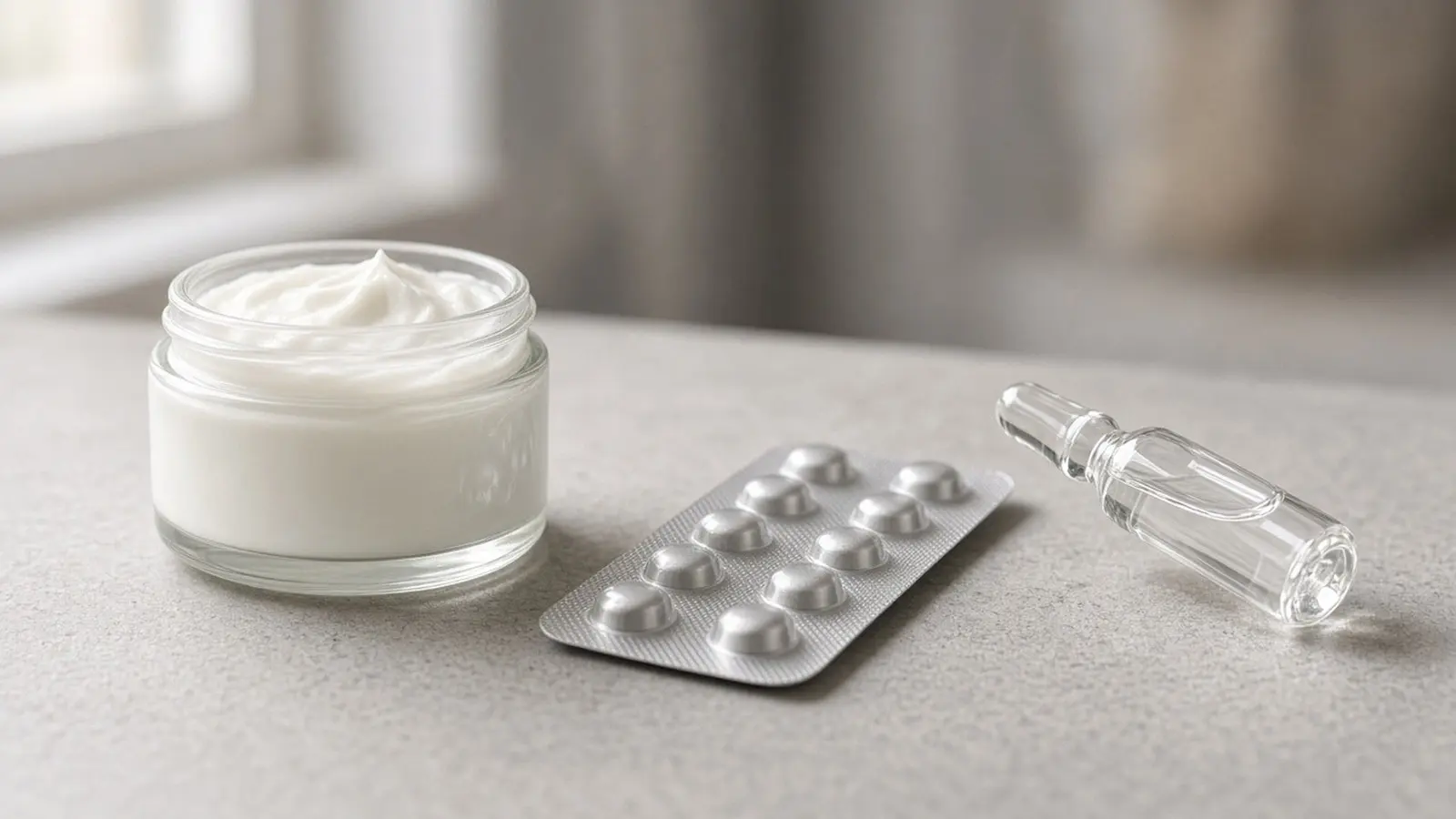
Glutathione cream caused no serious side effects in the published trials; a small number of users had mild redness where it was applied. Tablets cause short-lived wind or loose stools. Injections are the dangerous form: one trial recorded liver dysfunction in 32% of injected patients and one case of anaphylaxis, and neither the US FDA nor India's CDSCO approves glutathione injections for skin lightening.
What side effects does glutathione cream cause?
Glutathione cream caused no serious side effects in the trials that have been published. A 2025 narrative review in Cureus (Alzahrani and colleagues) found that topical glutathione produced mild localised erythema, meaning redness at the site of application, in a small percentage of participants, and nothing more serious. The best-designed trial, by Watanabe and colleagues, tested a 2% oxidised glutathione lotion on one side of the face against a placebo on the other side in 30 Filipino women aged 30 to 50 for 10 weeks; a 2018 review in Dermatology Practical and Conceptual (Sonthalia and colleagues) records that this trial reported no adverse drug effects.
The larger risk with creams is what else is in the tube. The US FDA warns that skin-lightening creams, soaps and lotions made abroad and sold illegally or through social media often contain mercury, which it does not allow in cosmetics. Mercury passes through skin and into breast milk, and family members can be exposed through towels and vapour.
Signs the FDA lists for mercury poisoning:
- irritability, shyness or depression
- tremors
- changes in vision or hearing
- memory problems
- numbness or tingling in the hands, feet or around the mouth
The FDA advises checking the label for the words "mercurous chloride", "calomel", "mercuric", "mercurio" or "mercury", and rejecting any product with no ingredient list at all. Glutathione itself is not the hazard in a cream; an unlabelled cream is.
What side effects do glutathione tablets cause?
Oral glutathione causes mild, short-lived gut upset and little else in the trials published so far. The Cureus review lists transient flatulence and loose stools during treatment periods of 4 to 10 weeks, which settled without any intervention, plus infrequent tingling or abdominal discomfort. The 2016 review in the Indian Journal of Dermatology, Venereology and Leprology (IJDVL) by Sonthalia, Daulatabad and Sarkar describes the expected side effects of oral glutathione as similar to those of high-dose vitamin supplements.
The same IJDVL review raises three theoretical concerns that no trial has confirmed or ruled out: depletion of the liver's own glutathione, worsening of ulcers linked to Helicobacter pylori, and a higher susceptibility to melanoma because the pigment shifts away from protective eumelanin. Hair lightening has been suggested but never reported in a trial.
Two facts matter for an Indian buyer. First, the IJDVL authors note that oral glutathione is sold over the counter in India, usually combined with vitamin C, so nobody checks the dose or who is taking it. Second, the trials were short: 4 weeks in the 60-student Thai trial and 8 weeks in the 30-woman lozenge study. The 2018 review states that no trial measured blood glutathione levels or ran liver, kidney or thyroid tests at baseline and follow-up, so there is no safety data for months of continuous use.

What are the side effects of glutathione injections?
Glutathione injections are the form with documented serious harm. The only placebo-controlled trial, by Zubair and colleagues in Pakistan, gave 1,200 mg intravenously twice a week for 6 weeks. The 2018 Dermatology Practical and Conceptual review reports that 8 of the 25 treated women (32%) developed liver dysfunction, one went into anaphylactic shock, and 9 of 25 dropped out. The review notes that the trial neither characterised nor quantified the liver dysfunction.
The Philippine FDA advisory, as cited in the 2018 review, lists further reported effects of intravenous glutathione:
- skin eruptions, including Stevens-Johnson syndrome and toxic epidermal necrolysis, both of which can be fatal
- severe abdominal pain
- thyroid and kidney dysfunction
- air embolism, and sepsis from unsterile technique or counterfeit product
The IJDVL review adds an unpublished observation of patchy loss of pigment on sun-exposed skin after 10 to 12 doses, and warns that the margin of safety is narrower because overdose is possible. Manufacturers recommend 600 to 1,200 mg once or twice a week with no stated duration, so there is no agreed stopping point.
Call 112 or go to the nearest emergency department the same day if, after a glutathione drip, you have swelling of the face or throat, difficulty breathing, a spreading rash with blisters or peeling, severe abdominal pain, or yellowing of the eyes.
The Cureus review concludes that intravenous glutathione should be restricted to carefully monitored clinical settings and not sold outside hospitals.
What do the FDA and CDSCO say about glutathione injections?
No regulator approves glutathione injections for skin lightening. The US FDA states in its consumer update on injectable skin-lightening products that it has not approved any injectable drug for skin whitening or lightening, and that products containing glutathione, vitamin C, collagen or human placenta sold for this purpose are unapproved new drugs that may contain unknown harmful ingredients or contaminants. The FDA adds that improper injection can spread disease, cause infection and lead to serious disability. In September 2014 US Marshals seized Relumins and Tatiomax glutathione whitening kits from one seller, and in 2017 a federal judge ordered the same company to stop distributing them.
In India, the Central Drugs Standard Control Organisation (CDSCO) has approved intravenous glutathione only for alcoholic fatty liver, alcoholic liver fibrosis, alcoholic liver cirrhosis and alcoholic hepatitis, according to the 2018 Dermatology Practical and Conceptual review. Skin lightening is not an approved indication, so every glutathione drip sold for glow or fairness in India is off-label. CDSCO's public-notice list also carries a notice titled "Use of Cosmetics" dated 19 May 2026; its text was not available to HealthFinder at the time of writing, so it is not quoted here.
The Philippine FDA, which licenses injectable glutathione only as an adjunct to reduce nerve damage from cisplatin chemotherapy, issued a public warning against skin-lightening use in 2011. The IJDVL authors, writing from India, concluded that dermatologists should refrain from giving intravenous glutathione for skin lightening until better trials exist.

Who should avoid glutathione for skin lightening?
The published reviews do not define a list of people who must avoid glutathione, because the trials never included anyone outside a narrow group of healthy adults. The Cureus review says only that caution applies to all users and that intravenous use needs a monitored clinical setting. The practical list below follows from who was studied and what went wrong.
- Pregnant and breastfeeding women. The trials enrolled healthy women and students aged 19 to 50 and excluded pregnancy, so there is no safety data. The FDA names pregnant women, nursing babies and young children as the most vulnerable to mercury in unlabelled lightening creams.
- Children. No trial included anyone under 19.
- Anyone with liver, kidney or thyroid disease. Liver dysfunction occurred in 32% of injected patients, the Philippine FDA lists thyroid and kidney dysfunction, and no trial monitored these organs.
- Anyone with a history of severe allergic reaction. One injected patient had anaphylactic shock.
- Anyone offered a drip at a salon, spa or home. The FDA links unsterile injection to infection and disability, and the 2018 review cites sepsis from unsterile technique and counterfeit product.
- Anyone with a stomach ulcer or melanoma risk should discuss the IJDVL review's theoretical concerns with a doctor before taking tablets.
A dermatologist can check pigmentation, rule out melasma or other treatable causes, and tell you which approved topical treatments exist; the FDA notes that approved topical drugs for hyperpigmentation and melasma are available.
Does glutathione actually lighten skin?
Glutathione produces a small, temporary lightening in some trials and none in others, and the effect disappears when you stop. Glutathione lowers tyrosinase activity and pushes melanin production from dark eumelanin towards lighter pheomelanin, according to the Cureus review, but the IJDVL review notes that it appears to affect only new pigment, not pigment already in the skin.
| Route | Trial | Result |
|---|---|---|
| Oral, 500 mg a day for 4 weeks | 60 Thai medical students, placebo-controlled | Melanin index fell at all six sites; significant versus placebo at two sites |
| Oral lozenge, 500 mg a day for 8 weeks | 30 Filipino women, no placebo | 27 of 30 (90%) rated lightening as moderate |
| Topical 2% oxidised glutathione, twice daily for 10 weeks | 30 Filipino women, split-face placebo | Melanin index fell significantly versus placebo; authors called the effect temporary |
| Intravenous 1,200 mg twice weekly for 6 weeks | 25 Pakistani women versus 25 placebo | 37.5% improved versus 18.7% on placebo; 6.2% versus 0% at six months |
The figures come from the 2018 Dermatology Practical and Conceptual review. A 2020 evidence-based review in Dermatology Research and Practice (Sitohang and Ninditya) re-analysed the same trials and found the intravenous result not significantly different from placebo, with only 1 of 16 patients keeping any improvement at six months; it judged oral glutathione "not beneficial enough" because it worked on some body areas only and did not last. No trial has run longer than 10 weeks.
What should you check before using any glutathione product?
Check the form, the label and the person selling it before you spend money or take a risk. The sources above support five checks.
- Prefer the cream or nothing. Creams are the only form with no serious adverse events in a controlled trial. Tablets are tolerable but unproven for lasting change. Injections have no approval anywhere for skin lightening and carry liver, allergy and infection risks.
- Read the ingredient list. The FDA says to reject any lightening product with no ingredient list or label, and to avoid the mercury terms listed earlier. Topical products sold for glutathione in India also come as face washes, soaps and peels, according to the IJDVL review; the same label rule applies.
- Use sunscreen. The 2020 Dermatology Research and Practice review states glutathione is not recommended for long-term use, especially without UV protection, because the pigment shift reduces the skin's own protection.
- Refuse any drip outside a hospital. The Cureus review says intravenous glutathione should not be sold outside the hospital setting, and the FDA ties unsterile injection to disease transmission.
- Report reactions. Stop the product and see a dermatologist or general physician if redness lasts more than a few days; a government hospital emergency department handles anaphylaxis and severe rashes, and 112 is the national emergency number.
This guide is general information from the sources listed below, not medical advice; a registered doctor makes decisions with you.