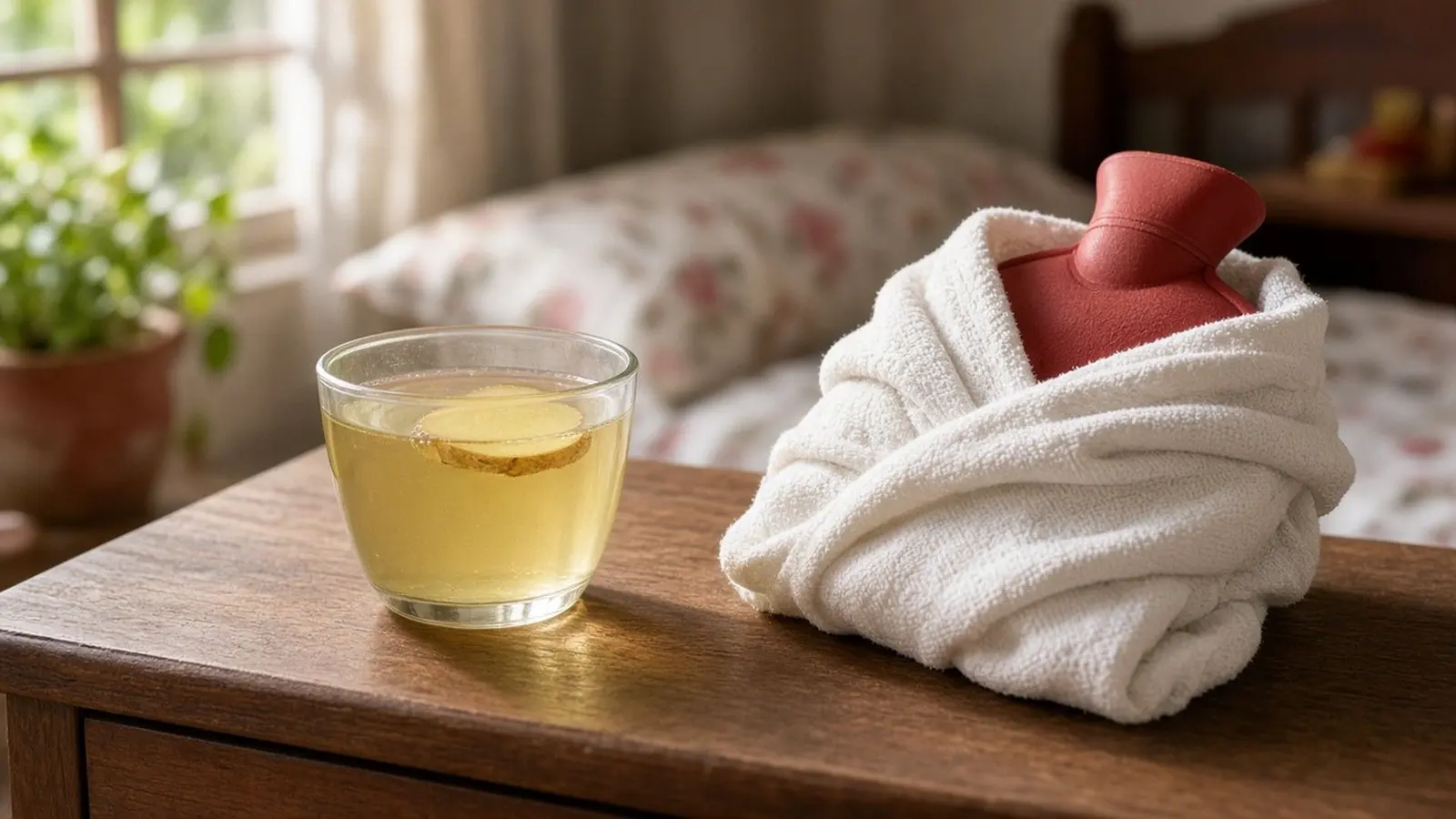
Herbal tea can take the edge off period cramps, but only ginger has a run of randomised trials behind it, and those trials are small and used ginger powder capsules rather than a brewed cup. Ibuprofen-type painkillers and a hot water bottle have far stronger evidence. Pain that stops you working, or that painkillers do not touch, needs a gynaecologist, not a different tea.
What causes period cramps?
Period cramps are caused by prostaglandins, chemicals the womb makes that force its muscle to contract. MedlinePlus says primary dysmenorrhoea, period pain with no other underlying condition, is usually linked to excess prostaglandins, and that it often begins soon after periods start and may ease with age or after childbirth. The NHS says the pain usually lasts up to 3 days, sits in the lower tummy at the start of a period or just before it, and can spread to the back and thighs as cramps, a sharp pain or a dull ache.

Doctors split period pain into two types:
- Primary dysmenorrhoea: no disease behind it. This is the common type and the one herbal teas are tested on.
- Secondary dysmenorrhoea: pain caused by a condition such as endometriosis or fibroids. MedlinePlus says it usually starts later in life, worsens over time, and may begin before the period and last after it ends.
Period pain is very common in India. A 2025 review in Global Health Action of 14 Indian cross-sectional studies from 2000 to 2022 reported dysmenorrhoea in 46% to 76% of women surveyed, and found that only 4% to 31% of those with menstrual problems sought treatment. That gap matters, because the most effective treatments are cheap and sold at every chemist.
Does ginger tea help period pain?
Ginger is the only common tea ingredient with several randomised trials showing a benefit, and even that evidence is weak. A 2021 systematic review and meta-analysis in Cureus pooled eight randomised trials, all from Iran. Across four placebo-controlled trials with 245 women, ginger reduced pain severity more than placebo. Two trials found no difference in how long the pain lasted. Two trials that compared ginger with an NSAID found the two about equally effective, but the trials disagreed with each other (I² 77%). The authors concluded that "these results must be viewed with great caution" because of the small number of trials, inconsistent methods and high heterogeneity.
The 2016 Cochrane review of dietary supplements for dysmenorrhoea reached a similar verdict: very limited evidence that ginger beats placebo or no treatment, from three trials with 266 women, and no high-quality evidence for any supplement.
Two details matter if you plan to rely on ginger:
- The trials used ginger powder in capsules, 500 mg to 1,500 mg a day, taken for 2 to 5 days from the start of the period (Cureus 2021). A cup of adrak chai contains an unmeasured, usually much smaller, amount.
- Side effects were minor: indigestion, heartburn and headache in a few participants.
So ginger tea is a reasonable thing to drink when cramps start. It is not a proven substitute for a painkiller.
Do chamomile, peppermint, cinnamon or fennel tea work?
Each of these has at most a handful of small trials, almost all from Iran, and most used capsules rather than tea.
| Herb | Best evidence | What it found |
|---|---|---|
| Chamomile | 2021 systematic review, 7 trials, 1,033 participants | Most trials reported less pain; forms were 250 to 500 mg capsules or brewed tea; no meta-analysis was possible; drowsiness was the only side effect. Cochrane 2016: one trial of 160 women, very limited evidence. |
| Peppermint | 2016 double-blind crossover trial, 122 students | Peppermint oil capsules and mefenamic acid 250 mg every 8 hours both cut pain; mefenamic acid shortened pain duration more; peppermint caused less nausea and vomiting. |
| Cinnamon | 2020 meta-analysis, 2 placebo trials | Lower pain intensity than placebo (mean difference 1.8 points), with high heterogeneity. Cochrane 2016 found the placebo data unsuitable for analysis. |
| Fennel | 2020 meta-analysis, 3 placebo trials | Small effect on pain intensity (0.5 points). Cochrane 2016: no consistent evidence of benefit over placebo, no difference from NSAIDs. |
The 2020 meta-analysis in the Journal of International Medical Research (9 trials, 647 patients) is the source for the cinnamon and fennel numbers. Its authors noted that every included trial came from Iran and that larger studies are needed.
The old version of this article also recommended raspberry leaf, lavender, hibiscus, nettle, dandelion, oregano, thyme, basil, wormwood, oolong, rose and green tea. None of the reviews cited here tested those, so this guide makes no claim for them.
What works better than herbal tea?
Anti-inflammatory painkillers and heat both have stronger evidence than any tea.
NSAIDs. A 2015 Cochrane review of 80 randomised trials with 5,820 women found that if 18% of women on placebo get moderate or excellent pain relief, 45% to 53% of women on an NSAID do. Side effects were slightly more common with NSAIDs (11% to 14% versus 10%), mainly indigestion, headache and drowsiness. No single NSAID was clearly better or safer than another, and NSAIDs appeared more effective than paracetamol, though only three trials made that comparison. The NHS suggests paracetamol or ibuprofen first, and says a GP can prescribe naproxen, flurbiprofen or mefenamic acid. MedlinePlus says NSAIDs work by reducing prostaglandin production, and should be avoided if you have ulcers, stomach or bleeding problems, liver disease or an aspirin allergy.
Heat. A 2018 meta-analysis in Scientific Reports pooled six randomised trials. A heat patch reduced pain by about 4 points on a 10-point scale compared with no treatment (132 women), and heat patches beat ibuprofen or paracetamol in two pooled trials (274 women). The patches in those trials held 38.9 °C to 40 °C for 8 to 12 hours. The NHS advises a heat pad or hot water bottle wrapped in a tea towel on the tummy, a warm bath, gentle exercise such as walking or yoga, and a TENS machine.

Hormonal contraception. The NHS says the pill, implant or injection thins the womb lining and makes periods lighter and less painful.
How do I use tea safely alongside painkillers?
Use tea as a comfort measure and take the painkiller early. MedlinePlus lists NSAIDs, heat on the lower abdomen, exercise, hot baths, rest and avoiding alcohol and tobacco as the core self-care for period pain; a warm cup of tea fits inside that list without replacing any of it.
A few points on safety come straight from the trials and reviews:
- Only four of the 27 trials in the 2016 Cochrane review reported side effects in both groups, so the safety of herbal supplements for period pain is poorly studied.
- Ginger capsules caused indigestion, heartburn and headache in a few women (Cureus 2021). Chamomile's only reported side effect was drowsiness (2021 review).
- Peppermint caused less nausea, vomiting and diarrhoea than mefenamic acid in the 2016 crossover trial.
- NSAIDs are not for everyone: MedlinePlus says to avoid them with ulcers, stomach or bleeding problems, liver disease or aspirin allergy. A pharmacist or general physician can check this for you.
None of the opened sources studied herbal tea in pregnancy or breastfeeding, so this guide gives no advice on that.
In India, ginger, cinnamon, fennel (saunf) and chamomile are cheap and sold everywhere, and ibuprofen, paracetamol and mefenamic acid are available at any chemist. If cramps need painkillers every month, one visit to a gynaecologist can rule out a treatable cause.
When is period pain not normal?
Period pain is not normal when painkillers do not control it, when it stops your daily activities, or when it appears outside your period. The NHS says to ask for an urgent appointment or call for same-day advice if pelvic or period pain is severe or worse than usual and not helped by painkillers.
See a doctor soon if your periods are becoming more painful, heavier or irregular; pain stops you working or studying; you have pain during sex or when peeing or pooing; you bleed between periods; your tummy is swollen; or you lose weight without trying (NHS). MedlinePlus adds: severe cramps for the first time after age 25, cramps that suddenly worsen, pain with fever, or pain outside your period.
In India, a gynaecologist at a private clinic or the obstetrics and gynaecology OPD of a government hospital handles this. Families covered by Ayushman Bharat can use an empanelled hospital at no cost. In an emergency, call 112 or go to the nearest government hospital casualty.
The 2025 Global Health Action review found that between 4% and 31% of Indian women with menstrual problems sought treatment, depending on the study. Most of the rest manage with home remedies and painkillers every month. If that is you, one visit can rule out a treatable cause, and the same NSAIDs you buy over the counter can be prescribed at a dose and timing that works better.
Could it be endometriosis or adenomyosis?
Two conditions explain many cases of period pain that painkillers do not control, and both are diagnosed with scans a gynaecologist orders.
Endometriosis. The NHS lists severe period pain that stops normal activities, heavy periods, pain when pooing or peeing, pain during or after sex, extreme tiredness and difficulty getting pregnant. It says endometriosis can take a long time to diagnose because its symptoms overlap with adenomyosis, fibroids, pelvic inflammatory disease and irritable bowel syndrome. A GP asks about symptoms and family history, may examine you and run blood tests, then refers to a gynaecologist. Tests are an ultrasound scan on the tummy or inside the vagina, an MRI scan, or a laparoscopy, where a camera is passed through a small cut in the tummy; laparoscopy confirms the diagnosis and affected areas can be removed in the same procedure.
Adenomyosis. The Cleveland Clinic describes tissue like the womb lining growing into the muscle wall, which can enlarge the womb to double or triple its usual size. Symptoms are painful periods, heavy or prolonged bleeding with clots, pelvic pain and painful sex; about 1 in 3 people have no symptoms. It is most common after 40, but about 2% to 5% of adolescents with severely painful periods have it. Transvaginal ultrasound can show a thickened wall and MRI can show enlargement. Heavy bleeding raises the risk of anaemia. Treatments range from NSAIDs and hormonal options to surgery.
This guide is general information from the sources listed below, not medical advice; a registered doctor makes decisions with you.