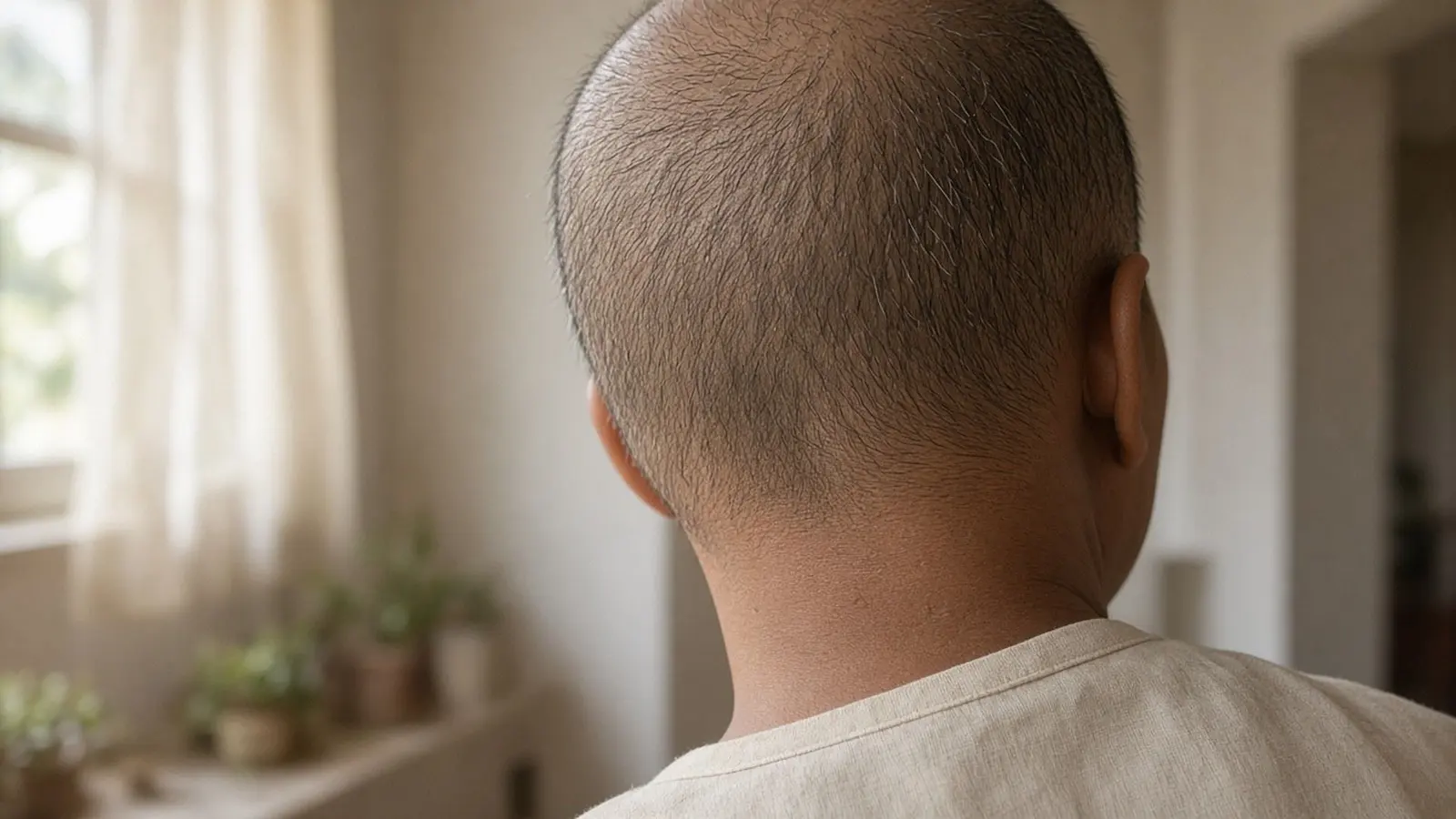
Hair almost always grows back after chemotherapy on its own, starting about 2 to 3 months after the last cycle, and the first growth is fine and often curlier or greyer than before. The only treatment with randomised evidence for faster regrowth is topical minoxidil, which shortened the bald period by about 50 days in a small trial; scalp cooling during chemotherapy prevents loss but does not speed regrowth. Oils, vitamins, biotin and platelet-rich plasma have no trial evidence in chemotherapy hair loss.
Why does chemotherapy cause hair loss?
Chemotherapy causes hair loss because it kills rapidly dividing cells, and the matrix cells at the base of a growing hair follicle divide faster than almost any other cell in the body. A 2024 review in Current Oncology explains that 80% to 90% of scalp follicles are in the growth (anagen) phase at any moment, so when a drug such as docetaxel stops their cell division the hair shaft weakens and sheds or breaks. This pattern is called anagen effluvium.
How much hair falls depends on the drug. A 2023 review in the same journal gives the incidence by class: more than 80% with antimicrotubule drugs such as paclitaxel, 60% to 100% with topoisomerase inhibitors such as doxorubicin, more than 60% with alkylating agents such as cyclophosphamide, and 10% to 50% with antimetabolites such as 5-fluorouracil. Combinations raise the figure further, which is why breast cancer regimens that pair an anthracycline with a taxane cause near-total loss.
The timing is predictable. A multicentre survey of 1,478 Japanese breast cancer patients published in PLoS One found scalp hair loss in 99.9% of women, beginning a mean 18 days (SD 12.6) after the first dose. The National Cancer Institute (NCI) adds that radiotherapy causes loss only in the area treated, and that after a very high dose hair there may regrow thinner or not at all.

When does hair grow back, and will it look the same?
Hair usually starts to grow back 2 to 3 months after chemotherapy ends, according to NCI, and the new hair is very fine at first. In the Japanese survey, regrowth occurred in 98% of patients and began a mean 3.3 months after the final cycle. After radiotherapy NCI puts regrowth at 3 to 6 months.
| Stage | Typical timing | Source |
|---|---|---|
| Hair starts to fall | Mean 18 days after first dose | PLoS One survey, 1,478 patients |
| Regrowth begins | 2 to 3 months after last cycle (mean 3.3 months) | NCI; PLoS One survey |
| Regrowth after radiotherapy | 3 to 6 months after treatment | NCI |
| Regrowth counted as incomplete | No or partial regrowth at 6 months | Current Oncology 2024 |
The new hair is often different. Six months after regrowth began, the survey found 58% of women reported thinner hair, 33% wavier or curlier hair plus another 30% whose straight hair became wavy or curly, and 38% greyer or whiter hair; 52% saw no colour change. NCI says regrown hair may be curlier, straighter or a different colour and may return to its pre-treatment look over time.
The survey also found that about 4% of women still had less than 30% scalp hair recovery two years after chemotherapy, and that this did not improve by five years. That minority is covered in the last section.
Does scalp cooling prevent hair loss?
Scalp cooling prevents hair loss in about half of women on common breast cancer regimens, and it must start with the first infusion. Cleveland Clinic describes the method: a tight cap circulates fluid at about 2°C to bring the scalp to 18°C to 22°C, worn for 30 to 60 minutes before, during and after each infusion; the cold narrows scalp blood vessels so less drug reaches the follicles.
The SCALP randomised trial in JAMA (2017) enrolled 182 women with breast cancer; at interim analysis 50.5% of the cooled group kept at least half their hair against 0% of controls, all adverse events were grade 1 or 2, and the trial stopped early for efficacy. The 2023 Current Oncology review gives average success rates of 50% to 70%, higher with taxane-only regimens and much lower with anthracycline-based ones; the 2024 docetaxel review reports success of 43% to 96% with docetaxel regimens against 95% to 100% with paclitaxel. In one study 77.5% of users had headache, dizziness or scalp or neck pain, yet 70.2% were satisfied.
Cooling is not for everyone. Cleveland Clinic lists blood cancers such as leukaemia and lymphoma, central nervous system cancers, planned skull radiation or stem cell transplant, migraine, liver disease and age under 18 as reasons to avoid it. A meta-analysis cited in the 2024 review found scalp metastasis in 0.67% with cooling versus 0.4% without, not a significant difference.
Cooling limits loss during chemotherapy; it is not a regrowth treatment. Ask the chemotherapy day-care unit before the first cycle whether it is available.
Does minoxidil help hair grow after chemo?
Topical minoxidil shortens the bald period but does not prevent loss. In a double-blind randomised trial of 22 women having adjuvant chemotherapy for breast cancer (Duvic, Journal of the American Academy of Dermatology, 1996), 2% minoxidil solution twice daily shortened the time from maximal hair loss to first regrowth by a mean 50.2 days, with no significant side effects. The 2023 Current Oncology review gives the figures as 87 days with minoxidil against 137 days with placebo, and adds a practical rule: start minoxidil after chemotherapy ends, not during it, because the drug dilates scalp vessels and could increase chemotherapy exposure around the follicles.
For hair that has not come back, the evidence is weaker but points the same way. A JAMA Dermatology case series (2021) of 100 breast cancer survivors with persistent chemotherapy-induced alopecia, 84 of them after docetaxel, assessed 49 who completed at least six months of treatment: topical minoxidil improved the median Sinclair grade from 4 to 3, low-dose oral minoxidil from 4 to 2.5, and oral minoxidil with an antiandrogen from 5 to 3. Oral minoxidil caused excess body hair in 14 patients, fluid retention in 3 and postural dizziness in 2, so it is a prescription decision.
The 2024 review describes 2% and 5% topical minoxidil as the strengths widely used, with low-dose oral minoxidil still under study. Start it with a dermatologist who can grade the hair loss, check for a scalp condition and decide whether oral minoxidil is appropriate.
What has no evidence for regrowth after chemo?
No oil, shampoo, vitamin or supplement has trial evidence for speeding hair regrowth after chemotherapy. The 2023 Current Oncology review of what is available and what is coming reports the following:
- Biotin and other "natural" products: studied mostly in pattern hair loss and alopecia areata, with no chemotherapy-specific evidence and weak evidence even there.
- Vitamin D (calcitriol): an early study found no benefit and caused dermatitis in five of eight patients; a later study of 23 patients was preliminary.
- Vitamin B6 with L-cystine: protected mice from doxorubicin hair loss, with no human data.
- Platelet-rich plasma (PRP): showed no protection or regrowth benefit in a rat model, and the 2024 docetaxel review says human trials are still running.
- Photobiomodulation (low-level laser): sped regrowth by about five days in newborn rats only.
The 2024 review lists bimatoprost, spironolactone, cyclosporine, antioxidants and topical calcitriol as agents with some signal in other chemotherapy alopecia that have still to be tested with docetaxel.
The practical conclusion is simple: time does most of the work, minoxidil is the one drug with trial support, and money spent on regrowth oils and serums is better spent on a good wig or a dermatology consultation. If a clinic offers PRP or laser for post-chemo hair, ask for the published trial in chemotherapy patients; the sources above found none.
How should I care for the scalp and new hair?
Gentle handling protects the fragile new hair and the tender scalp. NCI and Macmillan give practical, matching advice:
- Wash less often with a mild shampoo, and pat dry with a soft towel.
- Use a soft-bristle brush or wide-tooth comb; avoid hair dryers, straighteners, gels and tight clips that pull on the scalp.
- Wear sunscreen or a hat outdoors, and a soft cap, scarf or hair net at night to keep warm and catch loose hair.
- Use a plain lotion or conditioner if the scalp itches or feels tender.
- If shaving the head, use electric clippers on clean, dry hair and leave a very short layer rather than a razor or "0" setting, which cuts and risks infection.
- Choose cotton or light wool scarves; satin slides off.
- Remove hairpieces and clips before sleeping, and avoid extensions, weaves and tight plaits that strain fragile hair.
- Once hair returns, keep brushing, curling and blow-drying to a minimum.
For wigs, NCI advises buying one before hair loss begins so the colour can be matched, and switching to a scarf or turban if the wig feels hot or itchy. Macmillan describes full, half and three-quarter wigs and warns that loss can come earlier than expected, so order early. HealthFinder found no published Indian price survey for wigs, so this guide gives no rupee figure; prices depend on synthetic versus human hair and on construction, and some cancer hospitals run donation or subsidised wig programmes, which the oncology social worker can point to.
When should I worry about hair not growing back?
Worry if there is no regrowth, or only patchy regrowth, six months after the last chemotherapy cycle. The 2024 Current Oncology review defines persistent chemotherapy-induced alopecia (pCIA) as incomplete or absent regrowth at that point. It is most linked to taxanes: in a UK study 23.3% of docetaxel patients reported pCIA against 10.1% after paclitaxel, and in a Spanish series 35% to 52% of patients who received more than 400 mg/m² of docetaxel had grade 1 persistent thinning.
The JAMA Dermatology series shows pCIA is often partly reversible with minoxidil, so a six-month wait should end in a consultation, not resignation. A dermatologist grades the loss, looks for other causes and decides whether topical or oral minoxidil is appropriate.
See a dermatologist if hair has not started to regrow 6 months after the last cycle, if regrowth stops or reverses, or if the scalp is painful, red or weeping. Tell your oncologist before starting any hair treatment while still on hormone therapy or targeted drugs.
For radiotherapy to the head, NCI notes that a very high dose can leave the treated patch thin or bare permanently; the radiation oncologist can say whether the dose used makes that likely.
This guide is general information from the sources listed below, not medical advice; a registered doctor makes decisions with you.