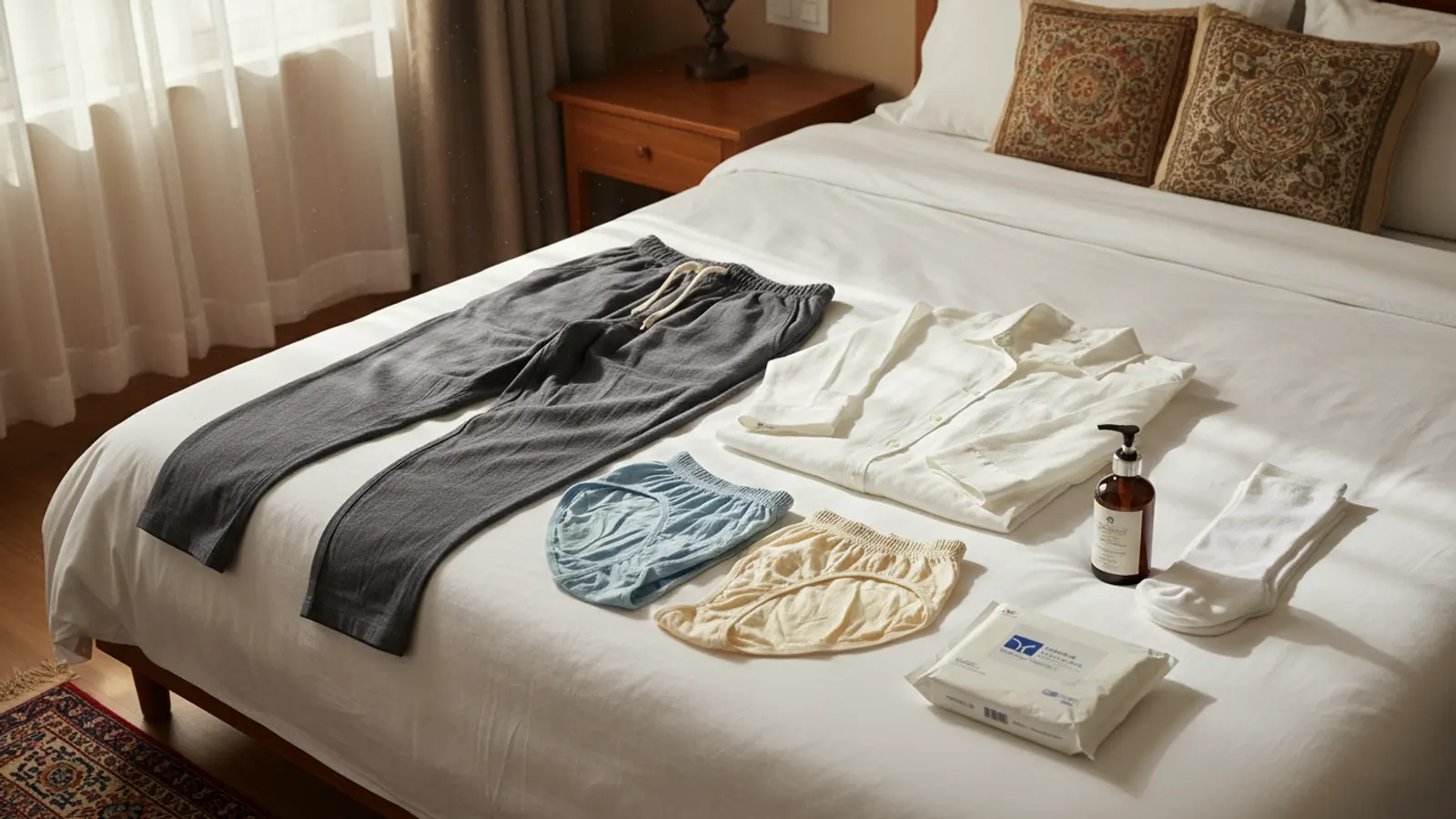
After prostate surgery you need loose, soft-waisted trousers that fit over a catheter leg bag for the first 1 to 3 weeks, then absorbent pads or pull-up pants while bladder control returns, plus supportive underwear for scrotal swelling and compression stockings if the hospital prescribes them. MedlinePlus advises no driving for 3 weeks and no lifting heavier than a 4-litre jug for 6 weeks after a radical prostatectomy. This guide covers clothing, catheter care, washing, activity limits and the warning signs that need same-day help.
What should you wear while the catheter is in?
Wear loose trousers or pyjamas with a soft elastic or drawstring waist, and strap the leg bag to the thigh or calf under them. The NHS says a catheter and bag "can be hidden under clothing" and that most everyday activities are still possible. A radical prostatectomy leaves the catheter in for 7 to 10 days according to Cancer Research UK, 1 to 2 weeks according to Macmillan, and 1 to 3 weeks according to MedlinePlus; the surgeon removes it at a clinic visit. In a Medanta Gurgaon series of 150 robotic prostatectomies published in the Indian Journal of Urology, the median catheter time was 7 days.
Practical choices that follow from the NHS advice:
- Trousers wide enough in the leg for the bag and straps (track pants, pyjamas or a lungi).
- No belt or tight waistband over the lower abdomen, where the keyhole wounds sit (Macmillan says laparoscopic surgery leaves 5 or 6 small wounds).
- Keep the bag below bladder level at all times; the NHS says collection bags "are always kept below the level of your bladder" to drain properly.
- At night switch to the larger night bag on a stand next to the bed, near the floor.
MedlinePlus adds that after open surgery the scrotum may stay swollen for 2 to 3 weeks, that supportive underwear helps, and that a folded towel under the scrotum supports it in bed.

How do you care for the catheter at home?
Keep urine flowing, keep the entry site clean, and never let the bag fill up. The NHS gives the routine: empty the leg bag "before it's completely full (around half to three-quarters full)", change leg bags and valves every 7 days, wash your hands before and after handling equipment, and wash the skin where the catheter enters the body with mild soap and water every day. Drink enough that urine stays pale, and eat fruit, vegetables and wholegrains to avoid constipation, because straining pulls on the wound.
MedlinePlus, in its radical prostatectomy discharge instructions, says dark red urine in the bag can be normal in the first days, but that you should call the surgeon if no urine drains for an hour. It advises at least 8 glasses of water a day and a stool softener so you do not strain. After TURP, MedlinePlus says bladder spasms and some leaking around the catheter are normal and the surgeon can prescribe medicine for the spasms.
Do not bathe. MedlinePlus says to avoid soaking in a bathtub, hot tub or swimming while the catheter is in; showers are fine. Catheter infection is the main risk the NHS lists, and the longer the catheter stays, the higher the risk.
In India, a prostatectomy catheter is removed at the hospital, not by a home nurse, so keep the clinic date even if the bag seems fine. If you live far from the hospital, ask the ward before discharge for spare leg bags, a night bag and the number to call if the catheter blocks.
What underwear and pads do you need after the catheter comes out?
Expect leaks for weeks to months; buy pads before the catheter comes out. Cancer Research UK says some leakage is likely when the catheter is removed, that it is usually temporary, and that you should keep pads at home and take a couple to the removal appointment. The NHS says the most popular products are absorbent pads worn inside underwear, with thin discreet pads and pull-up pants for mild to moderate leaks sold in supermarkets and pharmacies; for heavier leaks it lists urinary sheaths and drainage systems.
Close-fitting cotton briefs hold a pad in place; loose boxers let it shift.
How long it lasts:
| Source | Bladder control after radical prostatectomy |
|---|---|
| Cleveland Clinic | Good control for most at 6 to 12 weeks; can take 12 to 18 months |
| MedlinePlus | Near-normal control within 3 to 6 months |
| Medanta, Gurgaon (Indian J Urol 2015), under 70 | Pad-free 53.3% at 4 weeks, 79.4% at 3 months, 93.6% at 1 year |
| Same series, men 70 and over | 66.7% at 4 weeks, 87.9% at 6 months, 94.8% at 1 year |
Pelvic floor exercises help. MedlinePlus describes the method: tighten the pelvic floor for 3 to 5 seconds, relax for 3 to 5 seconds, 10 times, 3 times a day, with improvement expected after 4 to 6 weeks and full benefit over several months. If you cannot find the muscles, a pelvic floor physiotherapist can teach you; MedlinePlus says a referral is appropriate when you are unsure.
Do you need compression stockings and blood thinners?
Wear compression stockings if the hospital gives them, for as long as the nurse says, and complete any course of blood-thinning injections. Macmillan Cancer Support says compression (TED) stockings are worn before surgery and "for a period afterwards", that they must fit well without folds or wrinkles, and that the nurse will say how long to wear them and how to wash them. Macmillan adds that blood-thinning injections under the skin are usually given for 28 days at home, by you, a carer or a nurse.
The NHS explains why: after surgery a clot can form in a leg vein weeks later, so prevention may continue after discharge. Compression stockings are knee-high elastic socks that help circulation; walking regularly and drinking enough fluid also lower the risk. Cancer Research UK says to do the leg exercises the nurse or physiotherapist taught you.
Stockings go on first thing in the morning before swelling builds, under the loose trousers. Not every Indian hospital issues them; if yours does not, ask the surgeon whether you need them, and do not buy a random pair, because a wrong size can cut circulation.
See a doctor the same day if one leg becomes painful, swollen, warm or discoloured, especially the calf. Call 112 or go straight to emergency if you also have chest pain or breathlessness; the NHS says a clot that reaches the lungs is life-threatening. Do not drive yourself.
MedlinePlus lists pain, redness or swelling in the legs among the reasons to call the surgeon after both radical prostatectomy and TURP.
How do you bathe and look after the wound?
Shower, do not bathe, until the catheter is out and the surgeon agrees; keep the wounds clean and dry. MedlinePlus says you can remove dressings and shower once the skin is closed with stitches, staples or glue, but should cover Steri-Strips with plastic wrap for the first week. Clean the wound with mild soap and water, change the dressing once a day or when soiled, and avoid baths, hot tubs and swimming while the catheter is in.
Macmillan says you may have medical glue or dressings, that stitches are usually dissolvable, and that bruising and swelling around the cuts and the scrotum are expected. A drain below the belly button, if present, usually comes out after 1 to 3 days according to MedlinePlus.
Clothing matters for the wound as much as for the bag:
- Soft cotton tops that do not rub the belly-button cut.
- No belt, tight jeans or trouser button on the lower abdomen for the first weeks.
- Supportive briefs for the swollen scrotum, as MedlinePlus advises.
- Loose cotton kurta-pyjama or lungi at home in hot weather, to keep the wounds dry.
MedlinePlus also says to check with the surgeon before taking aspirin, ibuprofen or naproxen, because they affect clotting and can cause blood in the urine. Take only prescribed medicines and finish any antibiotics. After TURP, MedlinePlus says showers are allowed and baths are not until the surgeon confirms healing; the NHS says blood in the urine can return 10 to 14 days after TURP as part of recovery.
When can you drive, lift, work and have sex?
No driving for about 3 weeks, no lifting more than a 4-litre jug for 6 weeks, back to desk work in 2 to 3 weeks, and ask the surgeon before sex.
| Activity | Radical prostatectomy | TURP |
|---|---|---|
| Driving | Not for the first 3 weeks; stop every 2 hours on long trips (MedlinePlus) | 3 to 6 weeks (MedlinePlus) |
| Lifting | Nothing heavier than a 1-gallon (4-litre) jug for 6 weeks (MedlinePlus) | Nothing over 5 lb (2.3 kg) for 3 to 6 weeks (MedlinePlus); no heavy lifting for about 6 weeks (NHS) |
| Strenuous exercise | None for 6 weeks (Cancer Research UK); build up gradually after (MedlinePlus) | Avoid intense exercise for about 6 weeks (NHS) |
| Work | Many return in 2 to 3 weeks; physical jobs longer (Cleveland Clinic) | When you can tolerate most activities (MedlinePlus) |
| Sex | Ask surgeon or nurse (Macmillan); wait 6 weeks before anal sex (Macmillan) | Avoid for 3 to 4 weeks (MedlinePlus) |
MedlinePlus says tiredness lasts 3 to 4 weeks after radical prostatectomy; walk indoors, then outdoors, before anything heavier.
On Indian roads the 3-week driving limit is a minimum: do not ride a scooter or motorbike until the catheter is out, the wounds have closed and you can brake hard without pain. Ask the urologist for a written fitness note if your employer needs one.
Which warning signs need same-day help?
A fever, a catheter that stops draining, a painful swollen leg, or a wound that turns red and leaks all need a call the same day. MedlinePlus lists the signs for both radical prostatectomy and TURP, and the NHS gives a matching list for TURP.
Call the surgeon or go to emergency the same day if you have: a temperature above 38°C or feel hot, cold or shivery; no urine in the catheter bag for an hour, a blocked catheter or one that has fallen out; more blood in the urine, clots or jelly-like blobs; inability to pass urine after the catheter is out; belly pain that painkillers do not control; wound redness, warmth, bleeding or thick yellow or green discharge; pain, redness or swelling in a leg; or trouble breathing or a cough that will not go. In India dial 112 for an ambulance if you cannot reach the hospital.
For catheter problems the NHS adds severe or ongoing bladder spasms, urine leaking around the catheter and signs of urine infection such as lower abdominal pain. Keep the ward's 24-hour number from your discharge papers by the phone; Macmillan says hospital teams give one for exactly this purpose.
Return to the hospital that operated, where the notes are, and bring the discharge summary. A urologist handles catheter and bladder problems, and a pelvic floor physiotherapist handles leaks that persist beyond the first months. This guide is general information from the sources listed below, not medical advice; a registered doctor makes decisions with you.