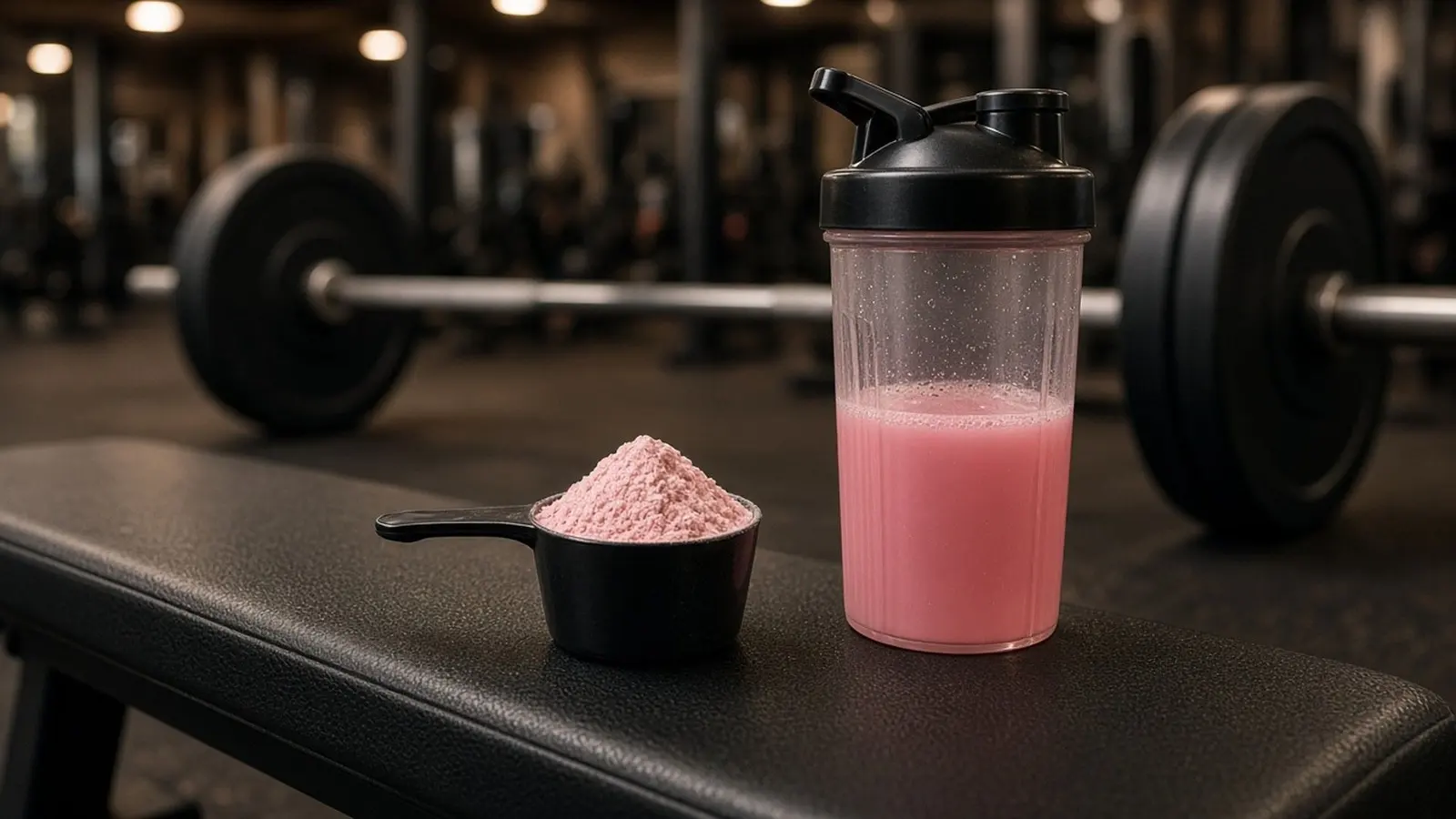
Pre-workout makes you itch because most formulas contain beta-alanine, an amino acid that triggers a harmless tingling called paraesthesia in the face, neck and hands. The International Society of Sports Nutrition's position stand says it is common above about 800 mg in a single dose and usually disappears within 60 to 90 minutes. Niacin can cause a similar flush. Itching with hives, swelling or wheezing is different: that is an allergy.
Why does pre-workout make you itch?
The itch comes from beta-alanine, which stimulates a specific type of nerve ending in the skin. Beta-alanine is a non-essential amino acid the liver makes, and the International Society of Sports Nutrition (ISSN) position stand explains that supplementing it raises muscle carnosine, which buffers acid in working muscle. That is why it is in most pre-workout powders. The position stand states that paraesthesia, meaning tingling, is the most widely known side effect of beta-alanine and that it is typically felt in the face, neck and the back of the hands.
The mechanism was worked out in a 2012 study in the Journal of Neuroscience by Liu and colleagues. In mice, beta-alanine itch required a receptor called MrgprD, found on a small subset of sensory neurons that supply only the skin. Those neurons respond to beta-alanine, heat and painful mechanical stimuli but not to histamine. In 11 human volunteers, beta-alanine injected into the skin produced itch in every subject, but no wheal or flare, the red raised bump that histamine causes. The authors concluded the itch was not mediated by histamine.
This explains two things people notice. First, the tingling is not a rash: the skin usually looks normal. Second, antihistamine tablets do nothing for it, because histamine is not involved. The sensation is the nerve firing in response to the amino acid, and it stops when the blood level falls.
How much beta-alanine causes the tingling?
Tingling is common once a single dose goes above about 800 mg of ordinary (non-sustained-release) beta-alanine, and it gets stronger with higher doses. The ISSN position stand says paraesthesia is commonly experienced in people taking more than 800 mg in a non-sustained-release form, and that it is dose-dependent. Many pre-workout scoops contain 1.6 to 3.2 g, which is why the effect is so familiar.
The position stand's dosing guidance:
| Point | ISSN position stand |
|---|---|
| Daily dose that raises muscle carnosine | 4 to 6 g a day for at least 2 to 4 weeks |
| How to split it | Divided doses of 2 g or less; 1.6 g doses reduce tingling |
| Loading period | About 4 weeks is needed to build carnosine |
| Single dose that commonly tingles | More than 800 mg, non-sustained-release |
| Tingling with sustained-release tablets | Substantially reduced |
| Long-term safety data | None beyond 1 year of use |
The point for anyone using it for performance: the benefit comes from the daily total over weeks, not from a large dose 20 minutes before training. The position stand says a loading phase of about four weeks is essential for raising carnosine. Splitting the day's amount into smaller doses with meals keeps the total the same and the tingling mild. One large scoop before the gym maximises the itch and adds nothing to the carnosine effect.

How long does the itch last and is it harmful?
The tingling usually goes within 60 to 90 minutes and there is no evidence that it is harmful. The ISSN position stand reports that in studies of non-sustained-release beta-alanine, paraesthesia has generally been reported to disappear within 60 to 90 minutes after supplementation, and states that to date there is no evidence to support that this tingling is harmful in any way. Its overall conclusion is that beta-alanine appears to be safe in healthy populations at recommended doses.
Two caveats come from the same document. There are no safety data on use beyond one year, so cycling off for a while or taking only what the evidence supports (4 to 6 g a day during a training block) is reasonable. And "healthy populations" is the group that was studied; people with kidney disease, who are pregnant, or who take regular medicines were not, and should ask a doctor before using any sports supplement.
What to expect in practice:
- Onset within 10 to 20 minutes of a dose, strongest at around 30 to 45 minutes, fading by 60 to 90 minutes (timings beyond the 60 to 90 minute clearance are everyday experience rather than a measured figure in the position stand).
- Face, scalp, ears, neck and backs of the hands first; sometimes the upper back.
- No rash, no swelling, no breathing change.
If the sensation lasts for hours, spreads to the whole body, or comes with any of the allergy signs described below, stop assuming it is beta-alanine.
Could niacin be causing a flush instead of an itch?
If the skin goes red and hot as well as itchy, niacin (vitamin B3) in the formula may be the cause. Some pre-workouts and "pump" products add nicotinic acid in doses far above dietary need. MedlinePlus describes the niacin flush as a feeling of warmth, redness, itching or tingling of the face, neck, arms or upper chest, and its prescribing information for niacin notes that flushing usually lessens after several weeks of regular use. MedlinePlus advises avoiding alcohol, hot drinks and spicy food around the time of the dose, because they make flushing worse.
The doses involved are small compared with a supplement label. The NHS says adults need about 16.5 mg of niacin a day for men and 13.2 mg for women, that taking high doses of nicotinic acid supplements can cause skin flushes, and that 17 mg or less a day of nicotinic acid supplements is unlikely to cause harm. Long-term high doses can damage the liver. The NHS also notes that the other form, nicotinamide, does not cause flushing; 500 mg or less a day of nicotinamide is listed as unlikely to cause harm.
How to tell the two apart:
- Beta-alanine: tingling or prickling, skin looks normal, mainly face, neck and hands.
- Niacin: visible redness and heat on the face, neck and chest, with itching, like a sunburn feeling.
Check the label: if niacin is listed well above the NHS daily figure, the flush is the likelier explanation, and a product without it is the simplest fix.
When is itching an allergy and not paraesthesia?
Itching is an allergy, not paraesthesia, when the skin itself changes or other body systems react. The NHS lists the signs of an allergic reaction: itchy or red skin, a raised rash (hives), swollen eyes, lips, mouth or throat, and coughing, wheezing or breathlessness. Symptoms can start within minutes or after a few hours. Beta-alanine tingling, by contrast, produces no wheal or rash and affects nothing but the skin sensation.
Pre-workouts contain many ingredients that can trigger an allergy: whey or milk derivatives, soy, egg, nuts, colours and sweeteners, and botanical extracts. A reaction to one of these needs the product stopped and the ingredient identified, not a smaller scoop.
Call 112 or go to the nearest hospital casualty immediately if, after a supplement, someone has swelling of the lips, tongue or throat, fast or difficult breathing, a tight throat, wheezing, a hoarse voice, feels faint or confused, or has skin, lips or tongue turning blue, grey or pale. The NHS says these are signs of anaphylaxis and it needs immediate treatment in hospital. If the person carries an adrenaline auto-injector, use it, and lie them down with legs raised.
For itching with a rash that is not an emergency, a dermatologist can distinguish hives from other skin reactions, and the NHS says a GP can arrange allergy tests such as a skin prick test or blood tests, or refer to an allergy clinic. Bring the product tub so the full ingredient list can be read.
Are pre-workout supplements regulated in India?
Yes, as food, not as medicine. The Food Safety and Standards Authority of India (FSSAI) regulates them under the Food Safety and Standards (Health Supplements, Nutraceuticals, Food for Special Dietary Use, Food for Special Medical Purpose, Functional Food and Novel Food) Regulations, 2016, notified on 23 December 2016. FSSAI's FAQ on these regulations makes two points that matter to a gym-goer. First, the quantity of nutrients such as proteins, vitamins, minerals and amino acids added to health supplements may not exceed the recommended daily allowance specified by the Indian Council of Medical Research (ICMR), or Codex standards where ICMR has none. Second, the labelling and advertising of these products may not claim that the product prevents, treats or cures any disease; FSSAI says products making such claims are more like drugs and fall outside its remit.
In practice a product sold legally in India carries an FSSAI licence number, declares its ingredients and amounts, and makes no disease claims; imported tubs from unverified online sellers may not.
Caffeine is the other ingredient to watch. The US FDA cites 400 mg a day as an amount not generally associated with harmful effects in healthy adults, and lists fast heart rate, palpitations, high blood pressure, insomnia, anxiety, jitters, upset stomach and headache as signs of too much. It warns that pure or highly concentrated caffeine products can be fatal, with toxic effects around 1,200 mg taken rapidly. Many pre-workouts contain 150 to 300 mg per scoop, so two scoops plus coffee is close to the limit.
How can you reduce the itch without stopping training?
The itch is reduced by taking less beta-alanine at a time, not by drinking more water or changing your diet. The ISSN position stand's own advice is divided lower doses of about 1.6 g, or a sustained-release formulation, both of which attenuate paraesthesia while keeping the daily total that builds carnosine.
Steps that follow from the cited sources:
- Read the label for the beta-alanine amount per scoop. Above 800 mg, expect tingling.
- Split the daily amount into two or three doses with meals rather than one pre-gym scoop; the carnosine benefit comes from weeks of daily intake, not from timing.
- Try a sustained-release beta-alanine tablet if the powder bothers you.
- Check for nicotinic acid (niacin) in the formula; if the reaction is a hot red flush, pick a product without it.
- Count total caffeine from all sources against the FDA's 400 mg a day figure.
- Stop the product and see a doctor if there is a rash, swelling or wheezing, which point to allergy.
If you do not want the tingling at all, you can leave beta-alanine out. Its benefit, per the position stand, is for efforts lasting about one to four minutes; it does not help a single heavy lift or a long easy run. A dietician with sports nutrition experience can tell you whether it suits your training. This guide is general information from the sources listed below, not medical advice; a registered doctor makes decisions with you.