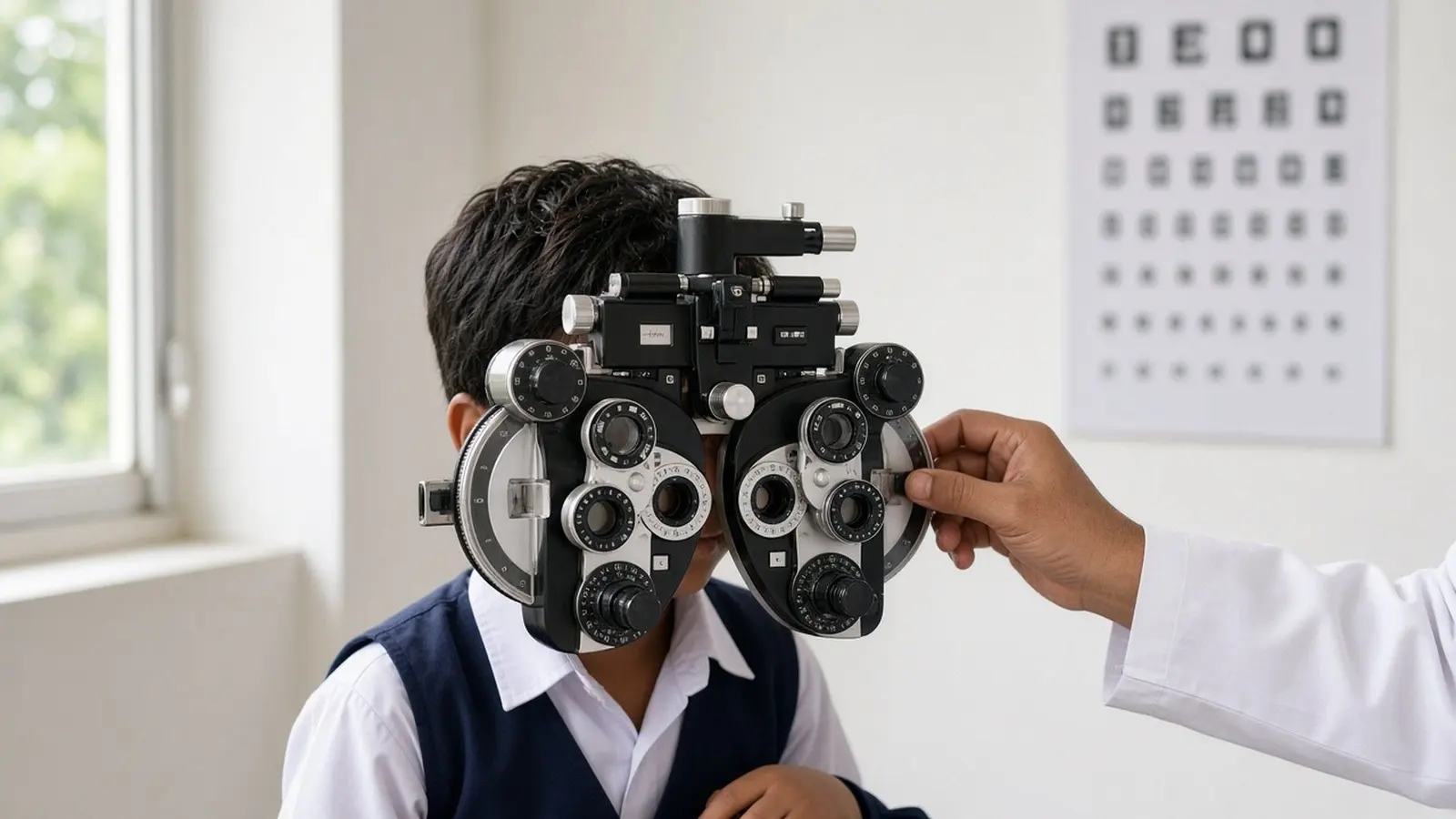
No study shows that yoga, trataka or any eye exercise reverses myopia, because myopia is an eyeball that has grown too long, and exercise does not shorten it. What the evidence does support is slowing progression in children with atropine drops, specially designed lenses and more time outdoors. Yoga has a modest, measured benefit for eye strain in computer users, which is a different problem.
Can yoga or eye exercises cure myopia?
No. The American Academy of Ophthalmology's patient page on myopia states that there is no scientific evidence that eye exercises, vitamins or pills can prevent or cure it. In an AAO "Ask an Ophthalmologist" answer dated September 2020, Richard Bensinger writes that "none of the suggested methods, like herbal supplements or eye exercises, have been shown to have any effect", and that even the treatments that do slow progression in children "will not reverse the myopia you already have".
Trataka (steady gazing), palming, eye rotations and "eye yoga" fall under the same verdict. The two trials of yoga eye practices that HealthFinder could open, described below, measured self-rated discomfort and fatigue. Neither measured refraction, axial length or visual acuity as an outcome, so neither can say anything about myopia.
The NHS page on short-sightedness says the condition "can usually be treated with glasses or contact lenses", that "it's not clear why short-sightedness happens, and it's hard to prevent it", and that laser or lens surgery is an option for some adults. The National Eye Institute lists the same three treatments and does not describe any cure.
Anyone who sells an exercise programme as a cure for myopia is selling something the professional bodies say does not exist.
Why can exercise not fix a short-sighted eye?
Because the problem is the shape of the eye, not the strength of its muscles. The National Eye Institute explains that "nearsightedness happens when your eyeball grows too long from front to back", so light focuses in front of the retina instead of on it; the shape of the cornea or lens can add to the error. The AAO adds that the cornea "may be too steeply curved, or your eye may be longer front to back than normal".
Timing follows from that. The NEI says myopia usually begins between ages 6 and 14 and "gets worse until your early twenties", while the AAO notes it is often found between 8 and 12, worsens during the teenage growth years and changes little between 20 and 40. Growth of the eye is the driver, which is why the treatments that work act on children's eye growth and why nothing is marketed for adults beyond correction.
Eye exercises train the muscles that move the eye; none of the sources describes a mechanism by which they shorten it.
Correction remains the treatment:
- Glasses, which the NEI calls the simplest and safest option.
- Contact lenses.
- Refractive surgery for some adults (LASIK, PRK, SMILE or lens exchange, per the AAO), with possible glare, halos and poor night vision, and, as the NHS notes, at private cost.
An ophthalmologist or optometrist should confirm the prescription before any of these.
How common is myopia among Indian children?
About one in thirteen school children, and rising fast in cities. Agarwal and colleagues pooled 59 Indian studies covering roughly 166,000 urban and 120,000 rural children in a 2020 meta-analysis in PLoS One. Myopia (at least −0.50 D) affected 7.5% of children aged 5 to 15 (95% CI 6.5 to 8.5), with 8.5% in urban and 6.1% in rural areas. Among 11 to 15-year-olds the figure was 10.7%.
The trend is the concern. For urban 11 to 15-year-olds, prevalence rose from 6.8% in studies published between 1980 and 2008 to 15.0% in studies from 2009 to 2019; rural adolescents rose from 6.9% to 12.3%. The authors call myopia "an emerging public health problem" for urban and rural adolescents alike.
| Group | 1980 to 2008 | 2009 to 2019 |
|---|---|---|
| All children 5 to 15 | 6.4% | 8.1% |
| Urban 11 to 15 | 6.8% | 15.0% |
| Rural 11 to 15 | 6.9% | 12.3% |
The NHS advises an eye test for any child who shows signs of short-sightedness, sitting close to the television or screen, squinting or struggling with the board, or who has not had an eye test in two years. The AAO warns that "young children with myopia might not complain about their blurry vision", so a school screening or a routine test is the usual route to diagnosis. A school screening referral should go to an eye hospital, government or private, for a full refraction.
What does slow myopia progression in children?
Atropine eye drops, certain multifocal or defocus lenses and orthokeratology, all under an eye specialist, all slowing rather than reversing. The 2020 Cochrane review by Walline and colleagues covered 41 randomised trials with 6,772 children. Compared with placebo, atropine slowed progression by about 1.00 dioptre at one year. Multifocal spectacles gave about 0.14 D less progression than single-vision lenses. Overnight orthokeratology lenses produced about 0.28 mm less axial growth. Atropine commonly caused blurred near vision, light sensitivity and discomfort; no serious adverse events were reported for any treatment.
The 2025 Cochrane living network meta-analysis, now 104 studies with 17,509 children, finds higher doses of atropine most effective, low doses small and uncertain, and orthokeratology the most effective optical option, though often poorly tolerated. Most studies ran two years or less, so durability is unknown.
| Intervention | Effect in Cochrane reviews | Certainty |
|---|---|---|
| Atropine drops | About 1.00 D less progression at 1 year; higher doses best | Moderate |
| Orthokeratology | About 0.28 mm less axial growth | Moderate; drop-out common |
| Multifocal spectacles | About 0.14 D less progression | Moderate, small |
| Defocus soft contact lenses | May reduce progression | Low |
| Eye exercises, yoga, supplements | No effect shown (AAO) | None |
The US FDA's approval record for the MiSight 1 day lens (P180035, November 2019) indicates it for slowing myopia progression in children aged 8 to 12 with −0.75 to −4.00 D. The NHS notes that myopia-management lenses are sold privately, not provided by the NHS.
Does time outdoors protect children's eyes?
More outdoor time lowers the chance that a child becomes myopic, with moderate-certainty evidence; its effect on children who are already myopic is uncertain. The 2024 Cochrane review by Kido and colleagues pooled five randomised trials with 10,733 primary-school children, all in China and Taiwan, where schools added outdoor classes or breaks. At two years, 22.5% of children in the outdoor groups had developed myopia against 26.7% of controls (risk ratio 0.84, 95% CI 0.72 to 0.98). At three years the figures were 30.5% against 39.8%, but from a single study and with a confidence interval that crossed no effect.
For progression in children already myopic, the differences were small: 0.13 D less refractive change at two years and 0.04 mm less axial growth, which the reviewers judged of low to moderate certainty. No adverse events were reported.
The AAO says "more time outdoors in natural light reduces a child's risk" and lists it as the first step in myopia control; the NHS lists spending more time outdoors, especially for children, as something that can help stop short-sightedness getting worse. The NEI notes that children who spend more time outdoors are less likely to be nearsighted, "but experts aren't sure why".

This is the one part of the "natural" approach that holds up, and it costs nothing. Outdoor play, outdoor sport and, for that matter, outdoor yoga all count; the exercise itself is not the active ingredient, the daylight and distance are the likely ones.
What can yoga actually do for your eyes?
Yoga eye practices reduce self-reported eye strain in two Indian trials, and that is the extent of the cited evidence. Telles and colleagues, in Head and Face Medicine in 2006, randomised 291 software professionals in Bengaluru to 60 minutes of daily yoga, five days a week for 60 days, or to a waiting list. The programme included postures, breathing, joint exercises, ten minutes of trataka and guided relaxation. On a 12-item visual discomfort questionnaire, the yoga group's mean score fell from 1.03 to 0.7 while the control group's rose from 1.05 to 1.5 (p < 0.001). The authors note that no objective dryness measure was taken, that the yoga group received more attention, and that only 62 of 146 yoga participants completed the study.
Gupta and Aparna, in the International Journal of Yoga in 2020, assigned 32 optometry students to 30 minutes of yoga ocular exercises (palming, blinking, side and diagonal viewing, nose-tip gazing, near and distant viewing) five days a week for six weeks, or to no exercise. Eye fatigue scores fell from 16.38 to 9.88 in the exercise group and rose from 16.19 to 19.06 in controls. The study was small, unblinded, and measured only a questionnaire; refraction was not an outcome.
So the honest claim is this: a routine of breaks, palming and distance gazing can make a long screen day feel better. No cited trial shows yoga changes tear film, refraction or the progression of myopia. Tired or gritty eyes still need the cause checked, and a child's myopia still needs management.
When is blurred vision an emergency?
Sudden floaters, flashes of light or a shadow across the vision need same-day help, because short-sighted eyes carry a higher risk of retinal detachment. The NHS lists short-sightedness, previous eye surgery, eye injury and a family history as factors that make detachment more likely, and the AAO says people with severe nearsightedness have a higher risk of retinal detachment, glaucoma, cataract and other eye diseases.
See an eye doctor the same day, or go to the emergency department of a hospital with an eye service, if you notice a sudden shower of floaters, flashes of light, a dark curtain or shadow moving across part of the vision, or sudden blurring in one eye. The NHS treats these as urgent. Call 112 if an eye injury accompanies them.
Other reasons to book an ophthalmologist appointment rather than an eye-exercise routine:
- A child whose prescription keeps rising at each test, the group for whom atropine or control lenses are considered.
- Headaches, squinting or holding books close, which the AAO lists as myopia symptoms in children.
- Red, painful or light-sensitive eyes, which no gazing practice should be done through.
Government medical college eye departments and regional institutes of ophthalmology offer refraction and retinal examination; large private eye hospitals offer the same plus myopia-control lenses at their own prices.
This guide is general information from the sources listed below, not medical advice; a registered doctor makes decisions with you.