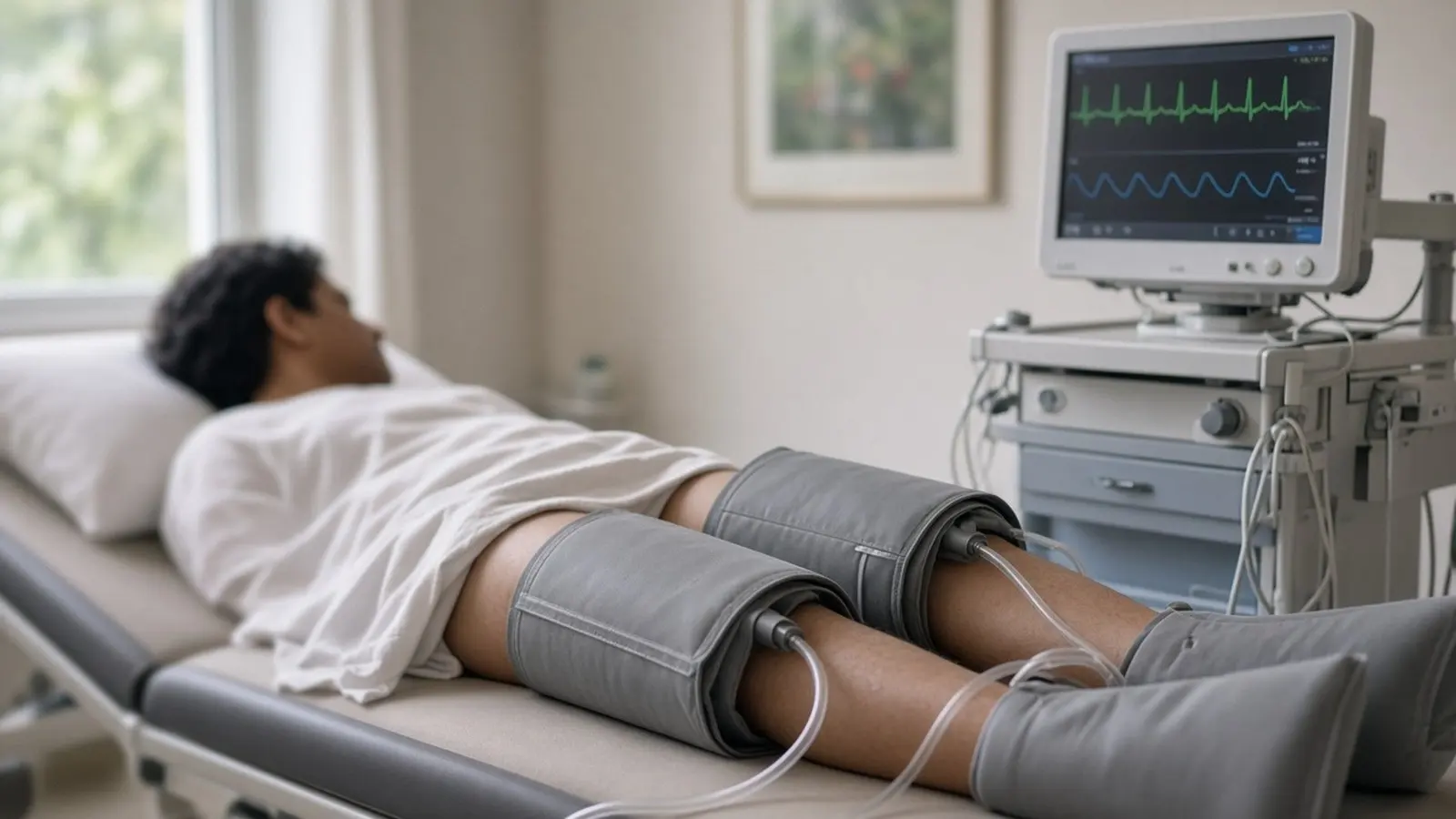
EECP (enhanced external counterpulsation) is a non-invasive outpatient treatment for chronic stable angina that persists despite medicines and cannot be helped by stents or bypass. Cuffs on the calves, thighs and buttocks inflate in time with the heartbeat across 35 one-hour sessions. The only blinded randomised trial, MUST-EECP, found it lengthened the time to exercise-induced ischaemia on a treadmill by about 40 seconds and reduced angina episodes, but did not improve exercise duration more than sham treatment; Cochrane calls the evidence inconclusive.
What is EECP and how does it work?
EECP is a treatment that squeezes the legs in time with the heartbeat to push more blood back to the heart between beats. Cleveland Clinic describes it as an FDA-approved, non-invasive outpatient therapy for chronic stable angina that does not respond to other treatments. Cuffs wrapped around the calves, thighs and buttocks inflate when the heart rests between beats (diastole), which raises blood pressure in the aorta while the coronary arteries are filling, and deflate just before the heart contracts, which lowers the resistance the heart has to pump against.
The timing comes from an ECG. A 2013 review in Clinical Medicine and Research by Sharma and colleagues explains that three sets of cuffs on each leg are triggered from the R wave of the electrocardiogram, inflating from the calf upward and releasing together. Cleveland Clinic lists what is attached before each session: three ECG patches, the leg and buttock cuffs, and a finger sensor that tracks the pressure waveform.
How a seven-week course produces relief that lasts months is less certain. Cleveland Clinic says the pressure increases blood flow to the heart and may encourage new vessel pathways that act as natural bypass vessels. Sharma's review treats the collateral-vessel and endothelial-function explanations as proposed mechanisms. The old HealthFinder post called EECP a "natural bypass"; no source opened for this guide uses that term as an established fact, so this guide does not either.
Who is EECP for?
EECP is for people with refractory angina: chest pain or pressure on exertion that continues despite the best medicines and that cannot be fixed with a stent or bypass. Cleveland Clinic lists the candidates as people with long-term chest pain or pressure that comes and goes with activity or stress, whose medication no longer relieves symptoms, who do not qualify for an invasive procedure such as surgery, or whose symptoms have returned after bypass, angioplasty or stenting. The 2021 review by Caceres and colleagues in the Journal of Clinical Pharmacy and Therapeutics describes the same "no-option" patient, one for whom further revascularisation is not possible.
Sharma's 2013 review lists EECP as a class IIb option for refractory angina, the guideline grade that means "may be considered", which is the weakest positive recommendation. The National Heart, Lung, and Blood Institute's angina treatment page lists beta blockers, nitrates, calcium channel blockers, antiplatelets, statins and ranolazine for refractory angina, and bypass or angioplasty as procedures; it does not mention EECP, which reflects its position at the end of the line, not the start.
EECP is therefore not a substitute for a stent or bypass in someone who can have one, and not a first treatment for new chest pain. Before any course, Cleveland Clinic says you have an examination and an exercise stress test; in India this is the treadmill test, and you can check TMT test cost and ask a cardiologist whether your angiogram and treadmill findings place you in the refractory group.
What did the MUST-EECP trial show?
MUST-EECP, published in the Journal of the American College of Cardiology in 1999, is the only randomised, blinded, sham-controlled trial of EECP for angina. It enrolled 139 outpatients with angina, documented coronary artery disease and a positive treadmill test at seven university hospitals, and gave them 35 hours of active or inactive (low-pressure) counterpulsation over four to seven weeks.
| Outcome | Active EECP | Sham | Between-group result |
|---|---|---|---|
| Time to 1 mm ST depression (seconds) | 337 to 379 | 326 to 330 | Significant (p = 0.01) |
| Exercise duration (seconds) | 426 to 470 | 432 to 464 | Not significant (p > 0.3) |
| Daily angina count | 0.76 to 0.55 | 0.76 to 0.77 | Trend only (p < 0.09) |
| Nitroglycerin use | Fell | No change | Not significant (p > 0.7) |
| Any adverse event | 55% | 26% | p = 0.001 |
The numbers come from the trial abstract and from the Cochrane and Clinical Medicine and Research summaries. Time to ischaemia on the treadmill improved by about 40 seconds more with active cuffs than with sham, and more active-group patients had fewer angina episodes. Exercise duration improved in both groups, which is the signature of a placebo and training effect, and nitroglycerin use did not differ.
Two caveats stay attached to the trial. Cochrane notes that the trial excluded class IV (most severe) angina, that staff were not blinded, and that the manufacturer sponsored it. Sharma's review reports that the benefit was maintained at 12 months in follow-up, but that was an open follow-up without the sham group. Adverse events were mostly leg pain, skin abrasions and bruising.
What do registries, later reviews and Cochrane say?
Registries report larger improvements than the trial. The International EECP Patient Registry, summarised in Sharma's 2013 review, found that 78% of patients improved by at least one angina class and that quality-of-life gains lasted at least two years. Caceres's 2021 review cites a pooled analysis of 13 observational studies (949 patients) in which 86% improved by at least one Canadian Cardiovascular Society class, and registry follow-up in which 70% of class III to IV patients kept the improvement and stayed free of major cardiac events at two years.
A 2021 systematic review in the Journal of Cardiovascular and Thoracic Research pooled 16 trials (582 patients) and one cohort (450) and found angina class improved by a mean of 2 grades across six studies, but the authors note the designs were before-and-after comparisons without a control group, no study followed patients beyond one year, and larger controlled studies are needed.
The Cochrane review by Amin and colleagues (2010) is the independent verdict. It found only MUST-EECP eligible, rated its risk of bias high, noted that quality of life improved significantly in only three of nine measures, and concluded there is a lack of reliable and conclusive evidence that EECP improves angina symptoms. No newer sham-controlled trial was found for this guide.
The honest summary: EECP probably reduces angina in some people, registry benefits are inflated by selection and placebo effects, and nothing shows it prolongs life or prevents heart attacks. Sharma's review says so: symptom improvement "does not guarantee improved survival".
What happens in a session, and how many sessions are needed?
A standard course is 35 one-hour sessions. Cleveland Clinic gives the schedule as one hour a day, five days a week, for seven weeks, or two one-hour sessions a day with a break between them for about three and a half weeks. About 20% of people need a repeat course, particularly those who did not complete the first 35 hours. In the registry data summarised by Sharma, 86% of patients completed the full 35 hours.
Before the first session there is an examination and an exercise stress test. For each session, Cleveland Clinic describes the routine: empty the bladder, change into treatment trousers, have three ECG patches, the cuffs and a finger sensor attached, then lie on the padded table while the cuffs inflate and deflate. People relax or nap. The sensation is a firm squeeze from the calves upward followed by quick release; it should be comfortable once you adjust, and it is not painful. You can go back to your normal routine straight after a session, although tiredness for several days is common at the start.
Improvement is not immediate. Cleveland Clinic says most people report improvement in the final couple of weeks of the course, so judging the treatment after five sessions is premature. Keep taking all angina medicines during the course unless your cardiologist changes them; the trial and registry results were measured on top of medical therapy, not instead of it. Cleveland Clinic also suggests planning an exercise programme with your provider during treatment, which fits the cardiac rehabilitation evidence for angina generally.
Who should not have EECP, and what are the side effects?
EECP is unsafe or unhelpful for a defined group, and a cardiologist should screen for it. Sharma's 2013 review lists the exclusions used in trials and registries:
- Heart rhythm disorders that interfere with the machine's ECG triggering
- Bleeding disorders or a tendency to bleed
- Active thrombophlebitis (clots in the leg veins)
- Severe blocked arteries in the legs (vaso-occlusive disease)
- An aortic aneurysm that needs surgical repair
- Pregnancy
The same review lists precautions where the decision is individual: decompensated heart failure, aortic regurgitation, severe mitral or aortic stenosis, uncontrolled high blood pressure, and a resting heart rate above 120. Cleveland Clinic adds pacemakers, atrial fibrillation, congenital heart disease, hypertrophic cardiomyopathy and pulmonary hypertension to the list of conditions where providers may recommend other options, and says plainly that EECP cannot treat unstable angina.
Chest pain that is new, comes on at rest, lasts more than a few minutes or is getting worse is unstable angina or a heart attack until proven otherwise. Do not book EECP; call 112 or go to the nearest emergency department.
Side effects are mostly from the cuffs. Cleveland Clinic lists fatigue, muscle aches, blisters or skin irritation, bruises, swelling, joint discomfort, numbness or tingling and pressure sores, and says that rarely people develop shortness of breath that needs hospital admission. In MUST-EECP, adverse events were reported by 55% of the active group against 26% on sham. Registry safety data in Sharma's review, from 2,511 patients, recorded death in 0.3%, heart attack in 0.9% and emergency revascularisation in about 1% during a course.
Where does EECP fit alongside medicines, stents and bypass in India?
EECP sits after the proven treatments, not before them. The sequence supported by the sources is: control risk factors and take the angina medicines the NHLBI lists (beta blockers, nitrates, calcium channel blockers, antiplatelets, statins, ranolazine); have an angiogram to see whether a stent or bypass can restore blood flow; and, only if neither is possible or symptoms persist afterwards, consider EECP as a symptom treatment. The old HealthFinder post called EECP "the best alternative to bypass surgery"; no source opened for this guide supports that, because bypass and angioplasty restore blood flow while EECP only relieves symptoms.
What a cardiologist will weigh for you:
- Is the angina truly refractory? That needs a recent angiogram and treadmill test.
- Are there exclusions, such as leg clots, an aneurysm, severe leg artery disease or rhythm problems?
- Can you attend 35 sessions in seven weeks? Incomplete courses are the main reason for repeat treatment.
- Is the medicine list already at the best tolerated doses?
On availability and price in India this guide stays silent on purpose: none of the authorities opened for it reports where EECP is offered in India or what it costs. Ask any centre for its exclusion checklist, who supervises sessions, and what stress-test or angina-class measurement it records before and after; a centre that cannot answer is selling hours, not treatment.
Discuss the decision with a cardiologist who does not run an EECP unit. This guide is general information from the sources listed below, not medical advice; a registered doctor makes decisions with you.