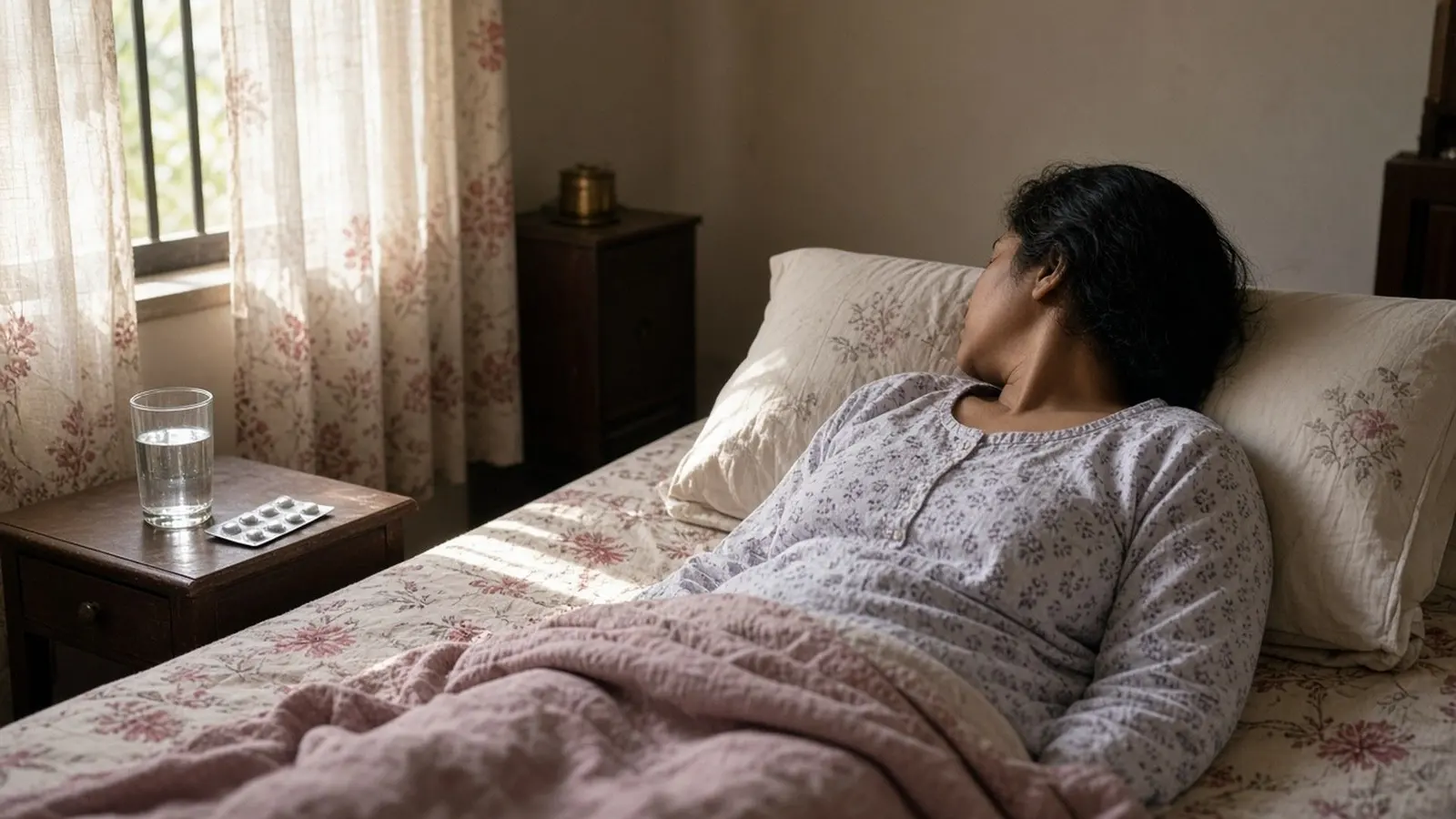
Sleep after keyhole gallbladder surgery in whatever position does not pull on the four small wounds, and use the log-roll to get in and out of bed. The first two or three nights are the hardest because trapped carbon dioxide gas irritates the diaphragm and shoulders; MedlinePlus says this eases over several days to a week. Most people are back to normal activity in one to two weeks, and sleep settles with it.
Which sleeping position is best after gallbladder surgery?
The best sleeping position after keyhole gallbladder surgery is the one that puts no pull on the wounds, and no official source names a single correct position. The NHS recovery page and the MedlinePlus discharge sheet for laparoscopic gallbladder removal do not prescribe how to lie. The rule they do give is clear: MedlinePlus says that if an activity causes pain or pulls on the incisions, do not do it. Apply that rule to bed.
In practice that means:
- Start on your back, with the head and upper body slightly raised on two pillows. This keeps weight off the four small cuts (one near the navel, two or three in the upper right belly, according to Cleveland Clinic).
- Side-lying is allowed once it does not hurt. The wounds sit on the right upper belly, so many people find the left side easier in the first days; test it and stop if it pulls.
- Avoid lying flat on the stomach until the wounds are closed and painless, because that position presses straight onto them.
- Keep the painkiller, water and phone within reach so you do not twist to get them.
The Royal Berkshire NHS day-surgery leaflet says discomfort should improve within 2 to 3 days and that normal activity can be resumed gradually after that. Expect the position question to matter for a few nights, not weeks.

How do I get in and out of bed without straining the wounds?
Get in and out of bed with the log-roll: roll onto your side in one piece, drop your legs over the edge, and push up to sitting with your arms. The Christie NHS Foundation Trust physiotherapy team teaches exactly this after abdominal surgery because it avoids excess strain on the tummy muscles, and it says the physio gets patients out of bed as soon as possible, usually the day after the operation, because getting up early eases wind pain and helps prevent complications.
Step by step:
- Bend your knees while lying on your back.
- Roll shoulders, hips and knees together onto your side, facing the edge of the bed.
- Let your feet slide off the edge as you push your upper body up with the lower elbow and then the hand.
- Sit for a moment before standing.
Reverse the sequence to get in: sit, lower onto the elbow, bring the legs up, roll onto your back.
The Royal Berkshire NHS leaflet asks patients to walk about gently as soon as they get home to lower the risk of leg blood clots, and MedlinePlus says to move around the house, shower and use stairs during the first week. A short walk before bed moves bowel gas and makes lying down easier. Avoid heavy lifting; the Royal Berkshire leaflet says four to six weeks, and MedlinePlus says at least a couple of weeks for strenuous activity.
Why are pain and gas worse at night after gallbladder surgery?
Pain feels worse at night because the carbon dioxide used to inflate the abdomen is still trapped under the diaphragm, and lying still lets it pool there. MedlinePlus says the gas left in the belly causes pain that can spread to one or both shoulders and that it should ease over several days to a week. A 2025 randomised trial in Langenbeck's Archives of Surgery (150 patients) states that shoulder pain affects 35 to 80% of patients after laparoscopic procedures, usually on the right, and puts the mechanism down to diaphragmatic irritation and phrenic nerve stimulation by the gas. In that trial the pain lasted a mean of 9.24 hours in the standard-ventilation group, so for most people the worst of it is the first night.
Three other things make nights harder:
- Painkillers wear off while you sleep, so the 3 a.m. wake-up is often an untreated dose gap.
- Bowel gas and bloating build up after a day of lying around; Cleveland Clinic lists gas pain as a direct side effect of the surgical gas.
- Constipation from opioid painkillers and rest; the NHS codeine page lists constipation and feeling sleepy among its common side effects.
What helps is simple. Walk for a few minutes before bed, sleep with the upper body raised so the gas rises away from the diaphragm, and time the last painkiller for bedtime. If the pain worsens over the first few days or becomes unbearable, the Royal Berkshire leaflet says to seek urgent medical attention.
Which painkillers help you sleep, and how should you take them?
Regular paracetamol or ibuprofen for the first few days is the standard advice, taken by the clock rather than when pain breaks through. The Royal Berkshire NHS leaflet says to take regular simple analgesia (paracetamol or ibuprofen unless allergic or advised otherwise) for the first few days and then as required. The NHS recovery page says the wounds will be painful for a few days and to take the painkillers you are given.
Ibuprofen has rules. The NHS says to take it with or after food, to leave at least 4 hours between doses, not to exceed six 200 mg tablets in 24 hours, and not to take it for more than 10 days without a doctor. It may not be suitable if you have a stomach ulcer, a heart, liver or kidney condition, or a clotting problem, and it should not be taken alongside aspirin or naproxen. Paracetamol can be taken with it.
If the surgeon prescribed a stronger opioid such as codeine or tramadol:
- Expect drowsiness; the NHS says do not drive, cycle or use machinery while sleepy.
- Expect constipation. MedlinePlus advises a high-fibre diet and 8 to 10 glasses of water a day after this operation.
- Take it only as prescribed, and ask the pharmacist before adding anything.
MedlinePlus says to contact the surgeon if pain is not relieved by the prescribed medicines. Pain that the tablets cannot touch is a symptom, not a sign to take more.
When does normal sleep return after gallbladder surgery?
Sleep returns to normal over the same one to two weeks that everyday activity does, with the first night the worst. A 2025 narrative review in Clocks & Sleep says post-surgical sleep disturbance affects an estimated 15 to 72% of patients, is typically worst on the first night, and can be detectable for weeks; it names pain as the most common cause and noise and light as the main environmental factors. That review covers all surgery; keyhole gallbladder removal sits at the mild end.
The recovery milestones from the sources set the expectation:
| Milestone | What the source says |
|---|---|
| Discomfort improving | Within 2 to 3 days (Royal Berkshire NHS) |
| Gas and shoulder pain gone | Several days to a week (MedlinePlus) |
| Back to most normal activities | About 1 to 2 weeks (MedlinePlus); about 2 weeks (Cleveland Clinic) |
| Return to work | 1 to 2 weeks depending on the job (NHS) |
| Normal energy | Several weeks (MedlinePlus) |
| Full recovery | Up to 6 weeks (MedlinePlus) |
| Heavy lifting | Avoid for 4 to 6 weeks (Royal Berkshire NHS) |
If you still cannot sleep after two weeks, look for the cause rather than the clock: untreated pain, an infected wound, worry, or an opioid that is still being taken. The Clocks & Sleep review names cognitive behavioural therapy as first-line treatment for insomnia itself, and a general physician can refer you. Tiredness alone is expected; MedlinePlus says regaining normal energy takes several weeks.
Which night-time symptoms after gallbladder surgery are red flags?
Fever, yellow skin, breathing difficulty and pain that the tablets cannot control are the night-time symptoms that cannot wait until morning. The NHS gallbladder removal complications page says to get an urgent GP appointment or call its helpline for severe or worsening pain that does not go away, pus from a wound, red tender or swollen wounds, yellow skin or eyes, leg swelling or throbbing pain, or a very high temperature with feeling hot, cold or shivery. MedlinePlus sets the fever line at 101 °F (38.3 °C) and adds grey stools, thick yellow or green wound drainage, a cough that does not go away and being unable to eat or drink. Cleveland Clinic adds persistent vomiting and dark urine.
See a doctor the same night if your temperature is above 38.3 °C, the whites of your eyes turn yellow, a wound leaks pus, or pain keeps rising despite the prescribed painkillers. Call 112 (India's emergency number) or go straight to the nearest emergency department if you have difficulty breathing, chest pain, or leg pain and swelling with breathlessness; the NHS says these can be a clot that has travelled to the lungs.
The NHS lists bile leak, bile duct injury, retained stones and wound infection as the complications to watch for, and calls them small or rare risks. In India a government district hospital or medical college emergency department handles these around the clock; eligible families can use empanelled Ayushman Bharat hospitals. Do not drive yourself; the NHS says to get someone to take you or call an ambulance.
What else changes in the first weeks after gallbladder removal?
Digestion changes for a few weeks, and that affects nights too. MedlinePlus says loose stools after eating can last 4 to 8 weeks, sometimes longer, and Cleveland Clinic says that for the first month or so fats and heavier meals are harder to digest. Both say most people return to a normal diet. The NHS advises a normal healthy diet, with small meals for the first few days. A heavy, fatty dinner close to bedtime is the single easiest cause of a bloated, uncomfortable night to remove.
Other expected effects: bruising around the wounds that clears on its own (MedlinePlus), a sore throat from the breathing tube, and nausea from the painkillers (Cleveland Clinic). A belly that looks bigger than before is usually gas, bloating or constipation; the companion guide on why the stomach looks bigger after gallbladder surgery covers that in detail.
If pain, bloating or diarrhoea persist past the sixth week, see a gastroenterologist. The NHS says post-cholecystectomy symptoms such as indigestion, tummy pain and diarrhoea usually improve soon after the operation and should be reviewed if they persist, and it lists retained stones in the bile duct as a cause of continuing pain or jaundice. An abdominal ultrasound is the usual first scan the specialist orders to look at the bile ducts and liver. This guide is general information from the sources listed below, not medical advice; a registered doctor makes decisions with you.